


Comparison of Discrete Factor Encoding Strategies and Factor-Level Optimization in Co-seismic Landslide Susceptibility Prediction
-
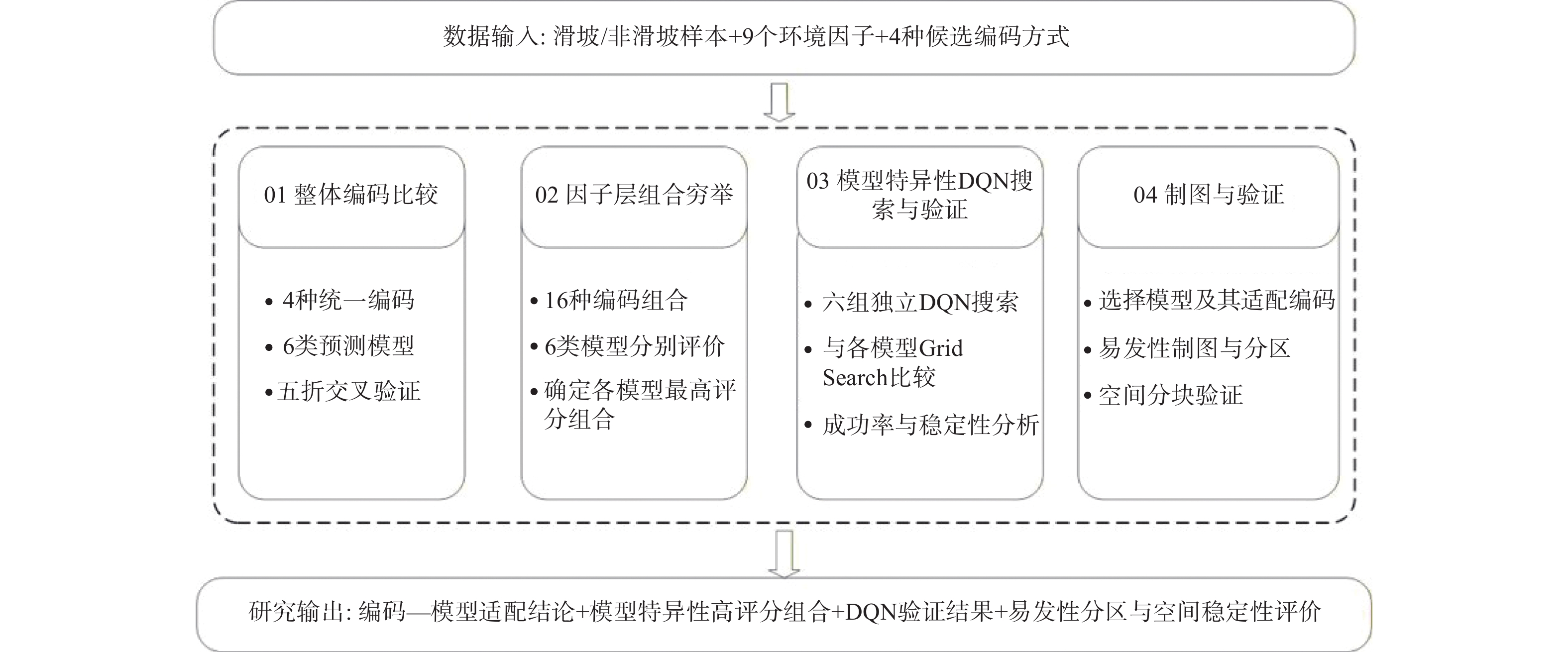
摘要: 同震滑坡易发性评价中,地层岩性、坡向等离散因子的编码方式会影响机器学习模型对地学信息的表达,但现有研究多依赖经验或默认编码方式,缺少针对不同模型和不同离散因子的系统比较。本文以汶川地震同震滑坡为例,选取地形、地质和地震动等9类因子,比较独热编码、标签编码、频率比编码和信息量编码4种编码方式在Logistic Regression、SVM、Random Forest、XGBoost、BP神经网络和LSTM中的表现,并进一步开展地层岩性与坡向的因子层编码组合评价。在此基础上,引入深度Q网络检验其对最优编码组合的稳定识别能力,并结合空间分块验证、基础地震动因子对照和Ⅸ度及以上区内部累积滑坡捕获曲线评价模型的空间稳定性与增量价值。结果表明,不同模型对离散因子编码方式具有不同偏好,因子层编码组合相较最佳统一编码的F1值提升总体较小,其主要价值在于揭示编码选择的模型依赖性和因子依赖性。深度Q网络(DQN)能够在当前小规模确定性奖励环境中稳定复现网格搜索结果,可作为编码组合自动搜索框架的概念验证,但不能证明其具有搜索效率优势。完整模型高值区主要受强震动和近断层效应控制,但在Ⅸ度及以上区仍提供了一定的相对排序信息。本文结果表明,离散因子编码优化的意义不宜仅理解为预测精度提升,更应作为类别变量处理和编码—模型适配检验的规范化框架。Abstract: In coseismic landslide susceptibility assessment, the encoding of discrete factors such as lithology and aspect can significantly affect how machine learning models interpret geological information. However, most existing studies rely on empirical or default encoding schemes, lacking systematic comparisons across different models and discrete factors. Taking the Wenchuan earthquake–induced landslides as a case study, this paper selects nine conditioning factors related to topography, geology, and ground motion, and compares four encoding methods—One-hot, Label, frequency ratio, and information value—across six models: Logistic Regression, Support Vector Machine, Random Forest, XGBoost, a back-propagation neural network, and Long Short-Term Memory. A factor-level encoding-combination evaluation is further conducted for lithology and aspect. On this basis, a Deep Q-Network (DQN) is introduced to examine its ability to stably identify optimal encoding combinations. The model’s spatial stability and incremental value are assessed through spatial-block cross-validation, comparison with basic ground-motion factors, and cumulative landslide capture curves within areas of intensity IX and above. The results show that different models exhibit distinct preferences for discrete-factor encoding methods. The F1-score improvement from factor-level encoding combinations over the best unified encoding is relatively small, and the main value lies in revealing model dependence and factor dependence in encoding selection. The DQN can stably reproduce Grid Search results in the current small-scale deterministic reward environment, serving as a proof-of-concept for an automated encoding-search framework, but does not demonstrate search-efficiency advantages. The high-susceptibility zones of the full model are primarily controlled by strong ground motion and near-fault effects, yet the model still provides some relative ranking information within areas of intensity IX and above. These findings suggest that the significance of discrete-factor encoding optimization should not be interpreted merely as an improvement in prediction accuracy, but rather as a standardized framework for categorical-variable processing and encoding-model compatibility testing.
-

图 1 研究区位置及同震滑坡、主要断裂与峰值地面加速度分布
Figure 1. Location of the study area and spatial distributions of coseismic landslides, major faults, and peak ground acceleration

图 3 不同编码策略下各预测模型的分类性能热力图
Figure 3. Classification performance heat maps of each prediction model under different overall coding strategies
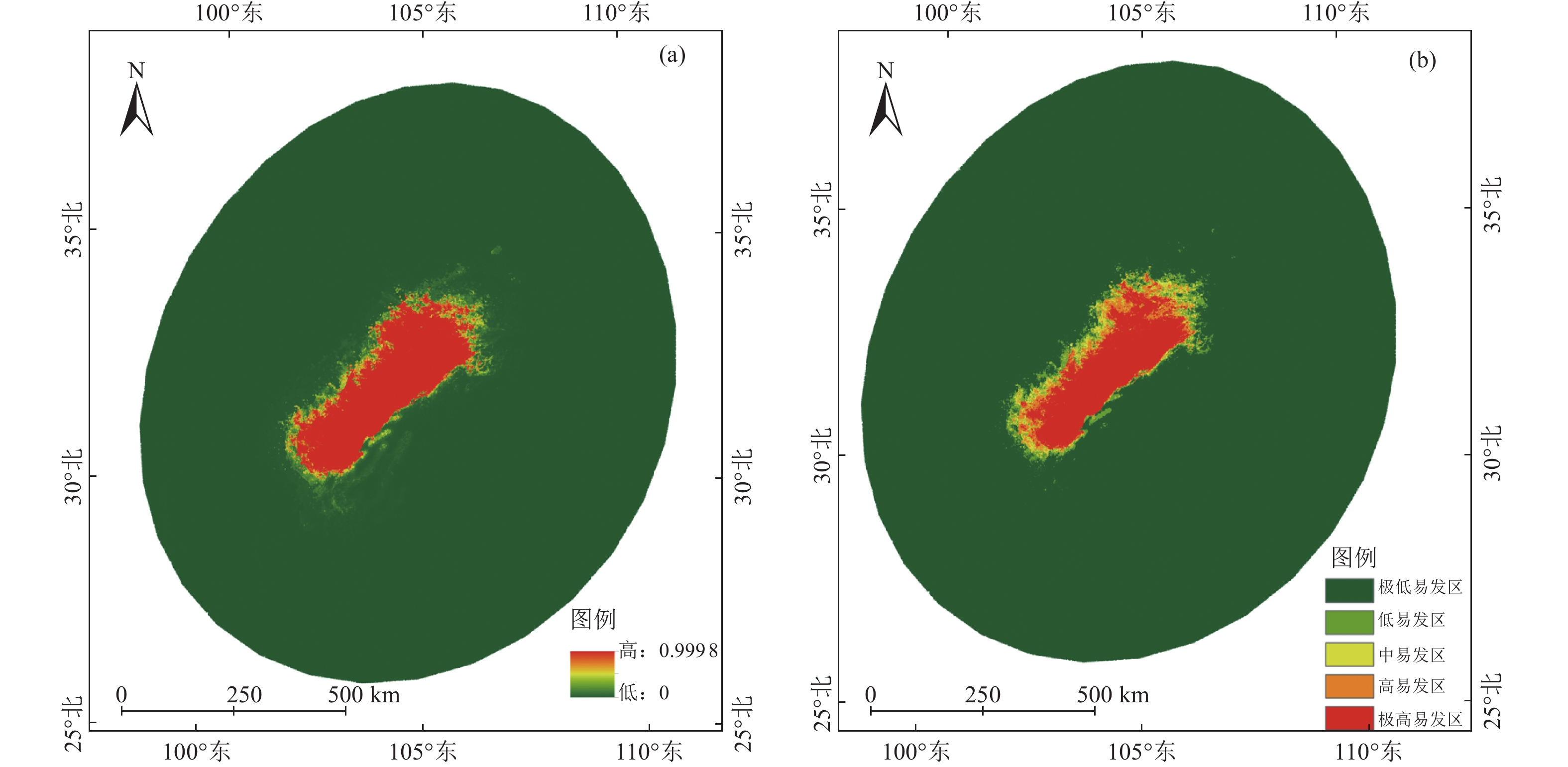
图 4 基于模型特异性编码组合与XGBoost的滑坡易发性分区图
Figure 4. Landslide susceptibility zoning map based on XGBoost with the OHE+FRE encoding combination
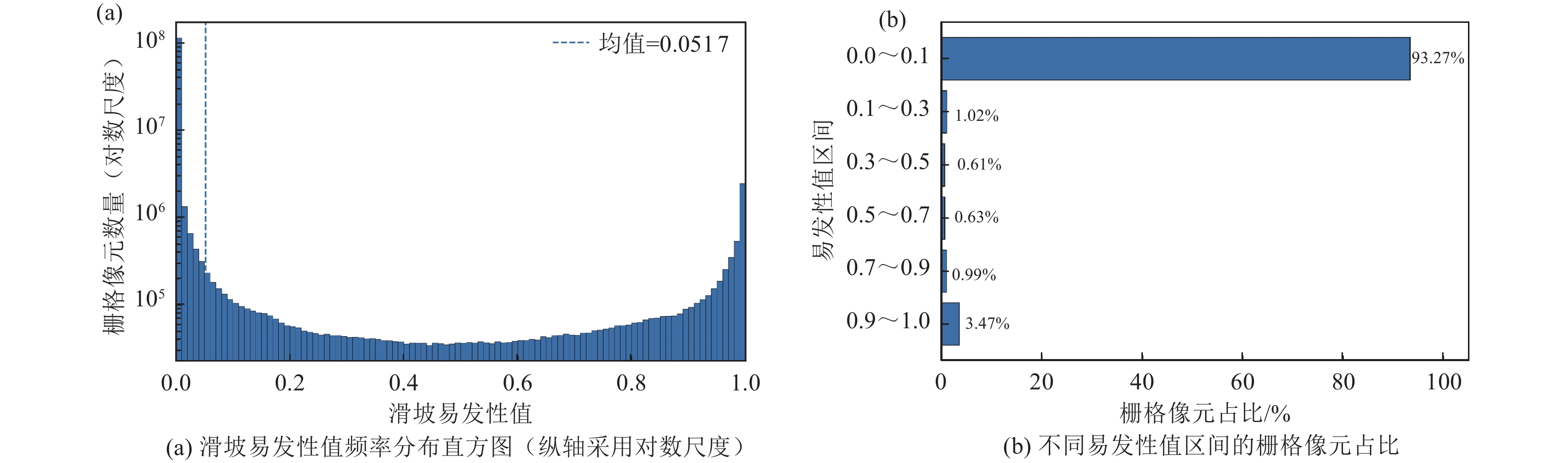
图 5 研究区滑坡易发性值的频率分布及区间占比
Figure 5. Frequency distribution and interval proportions of landslide susceptibility values in the study area
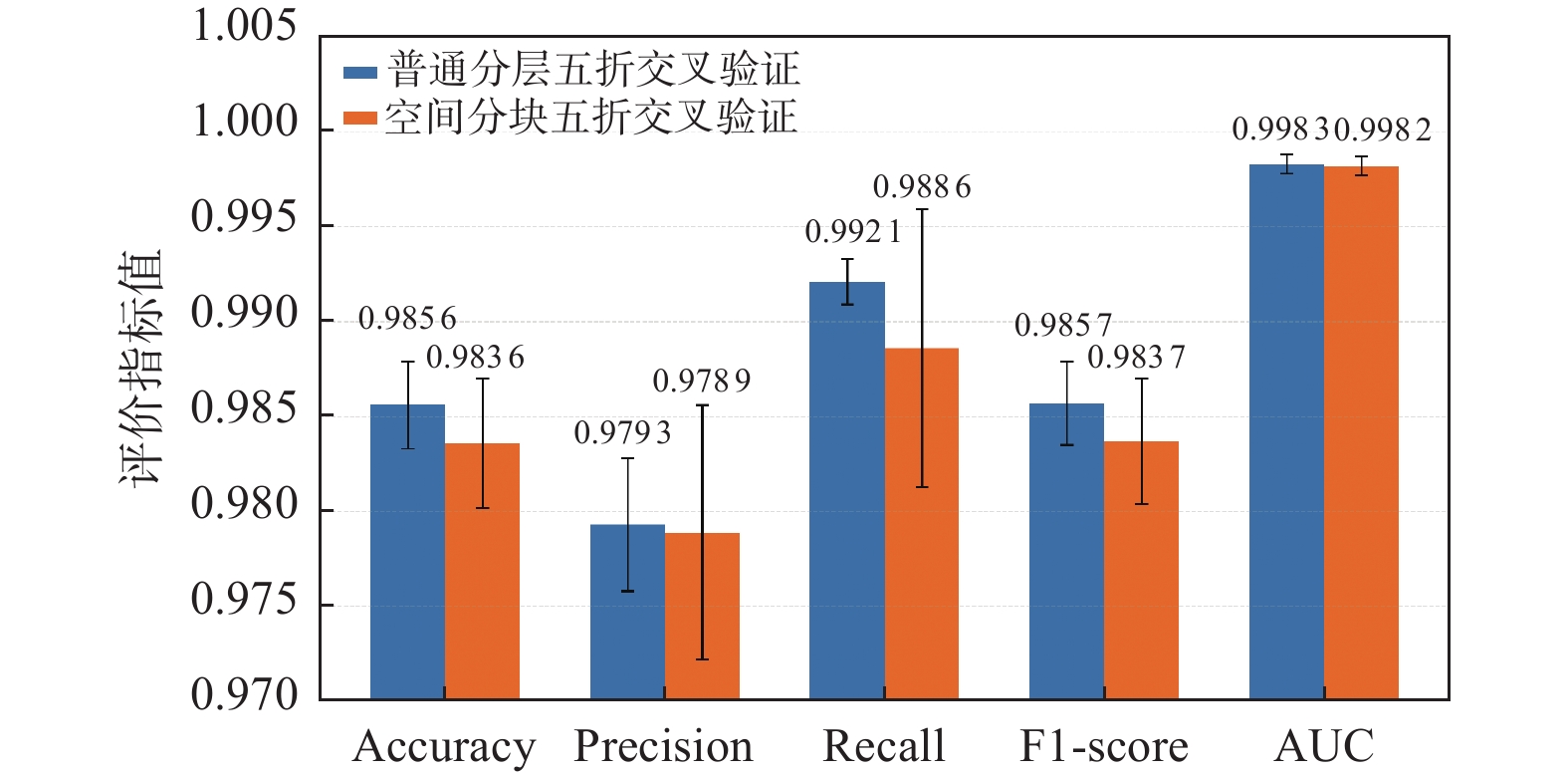
图 6 最终模型在普通交叉验证与空间分块交叉验证条件下的性能比较
Figure 6. Performance comparison of the final model between stratified five-fold and spatial-block five-fold cross-validation
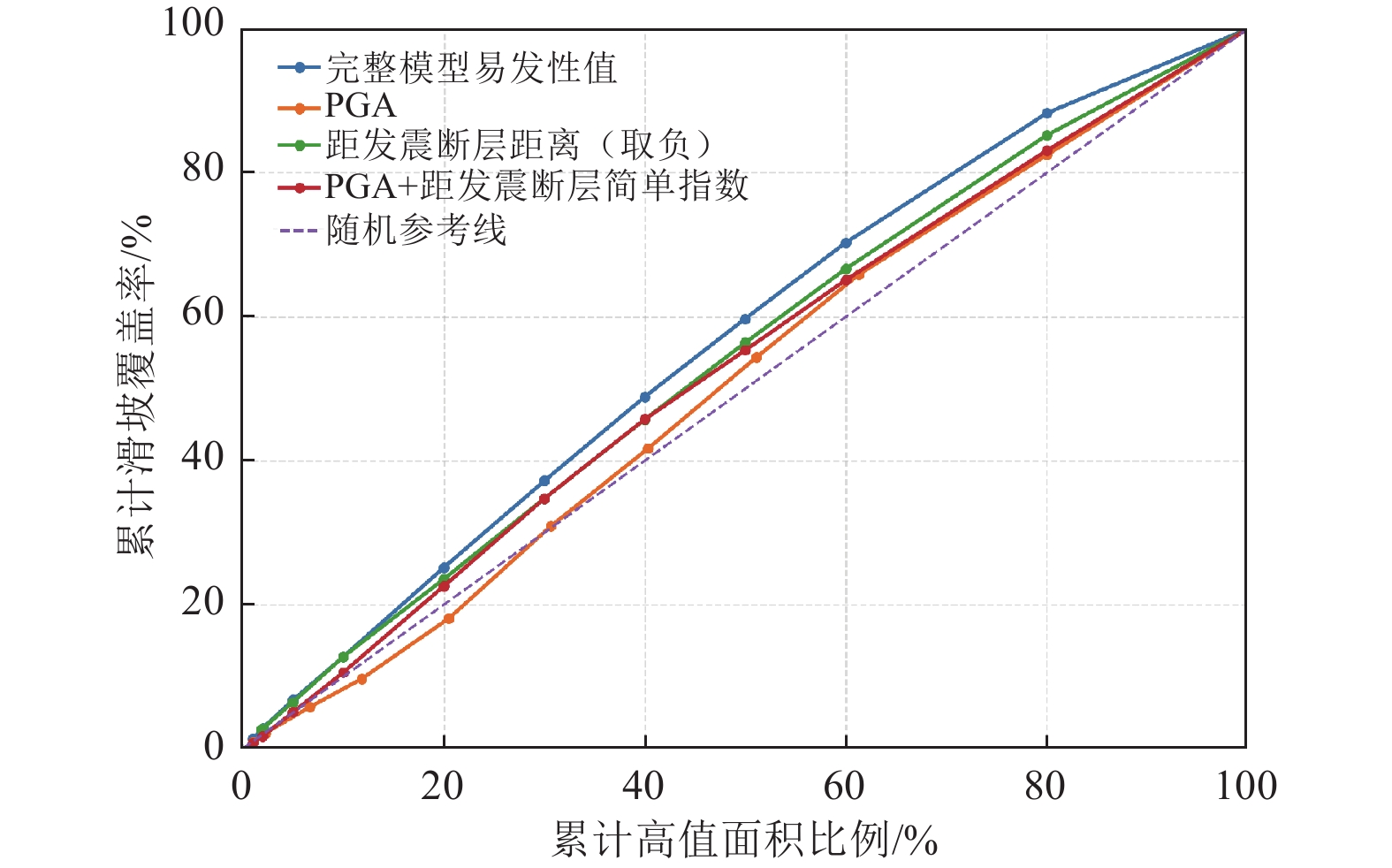
图 7 Ⅸ度及以上区内部完整模型与基础地震动因子的累积滑坡捕获曲线
Figure 7. Cumulative landslide capture curves of the full model and basic seismic factors within the intensity IX and above area
表 1 6类预测模型的预处理与参数设置
Table 1. Preprocessing and parameter settings of the six prediction models
模型 预处理 主要参数 LR StandardScaler L2正则化,solver=sag,(C=1.0),最大迭代2 000次,容差$ {10}^{-3} $ SVM MinMaxScaler RBF核,(C=0.1),gamma=scale,启用概率输出 RF 不进行标准化 决策树100棵,最大深度不限制 XGBoost 不进行标准化 树数200,最大深度5,学习率0.05,样本采样率0.8,特征采样率0.8,目标函数为binary:logistic BP StandardScaler 单隐藏层64个ReLU单元,Sigmoid输出,Adam优化器,学习率0.001,训练50轮,批大小256 LSTM StandardScaler LSTM单元64,Dropout为0.2,Adam优化器,学习率0.001,训练50轮,批大小256  下载: 导出CSV
表 2 不同统一编码方式下6类预测模型的五折交叉验证结果
Table 2. Five-fold cross-validation results of the six prediction models under different unified encoding strategies
编码方式 模型 准确率 精确率 召回率 F1值 AUC OHE LR 0.9779 ±0.0024 0.9782 ±0.0033 0.9776 ±0.0032 0.9779 ±0.0024 0.9972 ±0.0004 SVM 0.9641 ±0.0028 0.9648 ±0.0033 0.9635 ±0.0054 0.9641 ±0.0029 0.9950 ±0.0008 RF 0.9848 ±0.0026 0.9790 ±0.0036 0.9909 ±0.0019 0.9849 ±0.0026 0.9974 ±0.0009 XGBoost 0.9848 ±0.0026 0.9785 ±0.0040 0.9913 ±0.0012 0.9849 ±0.0025 0.9983 ±0.0005 BP 0.9807 ±0.0028 0.9785 ±0.0018 0.9829 ±0.0045 0.9807 ±0.0028 0.9977 ±0.0004 LSTM 0.9279 ±0.0223 0.8822 ±0.0391 0.9899 ±0.0062 0.9325 ±0.0193 0.9898 ±0.0063 LE LR 0.9788 ±0.0013 0.9774 ±0.0034 0.9802 ±0.0017 0.9788 ±0.0013 0.9972 ±0.0005 SVM 0.9799 ±0.0018 0.9783 ±0.0037 0.9816 ±0.0014 0.9800 ±0.0017 0.9976 ±0.0005 RF 0.9856 ±0.0021 0.9799 ±0.0037 0.9915 ±0.0011 0.9856 ±0.0020 0.9977 ±0.0007 XGBoost 0.9848 ±0.0021 0.9783 ±0.0042 0.9915 ±0.0013 0.9849 ±0.0021 0.9983 ±0.0004 BP 0.9826 ±0.0018 0.9796 ±0.0028 0.9857 ±0.0030 0.9827 ±0.0018 0.9980 ±0.0005 LSTM 0.9760 ±0.0026 0.9606 ±0.0043 0.9926 ±0.0021 0.9763 ±0.0025 0.9974 ±0.0005 FRE LR 0.9767 ±0.0020 0.9759 ±0.0028 0.9776 ±0.0040 0.9767 ±0.0021 0.9970 ±0.0006 SVM 0.9779 ±0.0020 0.9765 ±0.0040 0.9794 ±0.0020 0.9779 ±0.0020 0.9975 ±0.0006 RF 0.9848 ±0.0026 0.9787 ±0.0035 0.9911 ±0.0021 0.9849 ±0.0025 0.9975 ±0.0008 XGBoost 0.9848 ±0.0021 0.9783 ±0.0035 0.9916 ±0.0015 0.9849 ±0.0021 0.9983 ±0.0004 BP 0.9820 ±0.0019 0.9786 ±0.0028 0.9855 ±0.0029 0.9820 ±0.0019 0.9979 ±0.0006 LSTM 0.9731 ±0.0036 0.9537 ±0.0064 0.9944 ±0.0018 0.9736 ±0.0034 0.9973 ±0.0005 IVE LR 0.9770 ±0.0024 0.9762 ±0.0028 0.9779 ±0.0044 0.9770 ±0.0024 0.9970 ±0.0006 SVM 0.9779 ±0.0022 0.9764 ±0.0037 0.9795 ±0.0029 0.9779 ±0.0022 0.9975 ±0.0006 RF 0.9847 ±0.0025 0.9787 ±0.0035 0.9910 ±0.0020 0.9848 ±0.0025 0.9975 ±0.0008 XGBoost 0.9848 ±0.0021 0.9783 ±0.0035 0.9916 ±0.0015 0.9849 ±0.0021 0.9983 ±0.0004 BP 0.9817 ±0.0021 0.9791 ±0.0036 0.9845 ±0.0029 0.9818 ±0.0021 0.9979 ±0.0006 LSTM 0.9732 ±0.0029 0.9541 ±0.0065 0.9942 ±0.0024 0.9737 ±0.0027 0.9973 ±0.0005
下载: 导出CSV
表 3 6类模型对应的最高F1编码组合及预测性能
Table 3. Highest-F1 encoding combinations and predictive performance for the six models
模型 地层岩性编码 坡向编码 组合类型 准确率 精确率 召回率 F1值 AUC LR LE IVE 异质 0.9790 ±0.0013 0.9774 ±0.0033 0.9806 ±0.0018 0.9790 ±0.0012 0.9972 ±0.0005 SVM LE FRE 异质 0.9801 ±0.0012 0.9783 ±0.0033 0.9820 ±0.0022 0.9801 ±0.0012 0.9977 ±0.0005 RF LE FRE 异质 0.9856 ±0.0020 0.9794 ±0.0038 0.9919 ±0.0011 0.9857 ±0.0019 0.9978 ±0.0007 LE IVE 异质 0.9856 ±0.0020 0.9794 ±0.0038 0.9919 ±0.0011 0.9857 ±0.0019 0.9978 ±0.0007 XGBoost OHE FRE 异质 0.9856 ±0.0023 0.9793 ±0.0035 0.9921 ±0.0012 0.9857 ±0.0022 0.9983 ±0.0005 OHE IVE 异质 0.9856 ±0.0023 0.9793 ±0.0035 0.9921 ±0.0012 0.9857 ±0.0022 0.9983 ±0.0005 BP LE LE 统一 0.9826 ±0.0018 0.9796 ±0.0028 0.9857 ±0.0030 0.9827 ±0.0018 0.9980 ±0.0005 LSTM LE LE 统一 0.9760 ±0.0026 0.9606 ±0.0043 0.9926 ±0.0021 0.9763 ±0.0025 0.9974 ±0.0005
下载: 导出CSV
表 4 不同评价指标下6类模型的最高评分编码组合
Table 4. Highest-scoring encoding combinations of the six models under different evaluation metrics
模型 准确率最高组合 精确率最高组合 召回率最高组合 F1值最高组合 AUC最高组合 LR LE+IVE OHE+FRE LE+OHE / LE+IVE LE+IVE LE+LE SVM LE+FRE LE+FRE LE+FRE / LE+IVE LE+FRE LE+FRE RF LE+LE / LE+FRE / LE+IVE LE+LE LE+FRE / LE+IVE LE+FRE / LE+IVE LE+IVE XGBoost OHE+FRE / OHE+IVE OHE+FRE / OHE+IVE OHE+FRE / OHE+IVE OHE+FRE / OHE+IVE LE+LE BP LE+LE LE+LE LE+FRE / LE+IVE LE+LE LE+LE LSTM LE+LE LE+LE IVE+OHE LE+LE LE+OHE
下载: 导出CSV
表 5 模型特异性DQN搜索结果及其与Grid Search的一致性
Table 5. Model-specific DQN search results and their consistency with Grid Search
模型 Grid Search最高F1组合 DQN最终Greedy组合 历史最高奖励命中率/% 最终Greedy成功率/% LR LE + IVE LE + IVE 100 100 SVM LE + FRE LE + FRE 100 100 RF LE + FRE / LE + IVE LE + FRE / LE + IVE 100 100 XGBoost OHE + FRE / OHE + IVE OHE + FRE / OHE + IVE 100 100 BP LE + LE LE + LE 100 100 LSTM LE + LE LE + LE 100 100
下载: 导出CSV
表 6 不同滑坡易发性等级的面积及滑坡点分布统计
Table 6. Area and landslide-point distribution statistics for different susceptibility classes
易发性等级 面积/km2 面积占比/% 滑坡点数量/个 滑坡点占比/% FRE SCAI 极低易发区 1 172 693.68 93.164 6 4 0.042 9 0.000 5 2 169.571 低易发区 14 711.44 1.168 8 9 0.096 6 0.082 7 12.096 6 中易发区 10 348.78 0.822 2 47 0.504 6 0.613 7 1.629 4 高易发区 13 719.34 1.089 9 234 2.512 1 2.304 8 0.433 9 极高易发区 47 259.87 3.754 6 9 021 96.843 8 25.793 7 0.038 8
下载: 导出CSV
表 7 不同分值对滑坡样本的排序能力对比
Table 7. Comparison of ranking ability of landslide samples with different scores
分值类型 AUC PR-AUC PGA 0.993 5 0.991 7 距发震断层距离(取负) 0.993 0 0.991 2 PGA+距发震断层距离简单指数 0.993 7 0.992 5 完整模型易发性值 0.999 3 0.999 2
下载: 导出CSV
-
鲍帅, 刘纪平, 王亮, 2021. 联合DBSCAN聚类采样和SVM分类的滑坡易发性评价. 震灾防御技术, 16(4): 625−636.Bao S., Liu J. P., Wang L., 2021. Landslide susceptibility evaluation based on combined DBSCAN cluster sampling and SVM classification. Technology for Earthquake Disaster Prevention, 16(4): 625−636. (in Chinese) 陈晓利, 邓俭良, 冉洪流, 2011. 汶川地震滑坡崩塌的空间分布特征. 地震地质, 33(1): 191−202.Chen X. L., Deng J. L., Ran H. L., 2011. Analysis of landslides triggered by Wenchuan earthquake. Seismology and Geology, 33(1): 191−202. (in Chinese) 窦杰, 向子林, 许强等, 2023. 机器学习在滑坡智能防灾减灾中的应用与发展趋势. 地球科学, 48(5): 1657−1674.Dou J., Xiang Z. L., Xu Q., et al., 2023. Application and development trend of machine learning in landslide intelligent disaster prevention and mitigation. Earth Science, 48(5): 1657−1674. (in Chinese) 黄发明, 胡松雁, 闫学涯等, 2022. 基于机器学习的滑坡易发性预测建模及其主控因子识别. 地质科技通报, 41(2): 79−90. doi: 10.19509/j.cnki.dzkq.2021.0087Huang F. M., Hu S. Y., Yan X. Y., et al., 2022. Landslide susceptibility prediction and identification of its main environmental factors based on machine learning models. Bulletin of Geological Science and Technology, 41(2): 79−90. (in Chinese) doi: 10.19509/j.cnki.dzkq.2021.0087 黄发明, 陈杰, 杨阳等, 2025. 滑坡易发性相关致灾环境因子研究的综述与展望. 地质科技通报, 44(2): 14−37. doi: 10.19509/j.cnki.dzkq.tb20240766Huang F. M., Chen J., Yang Y., et al., 2025. A review and prospect of disaster-causing environmental factors related to landslide susceptibility prediction. Bulletin of Geological Science and Technology, 44(2): 14−37. (in Chinese) doi: 10.19509/j.cnki.dzkq.tb20240766 李勇, 黄润秋, 周荣军等, 2009. 龙门山地震带的地质背景与汶川地震的地表破裂. 工程地质学报, 17(1): 3−18.Li Y., Huang R. Q., Zhou R. J., et al., 2009. Geological background of Longmen Shan seismic belt and surface ruptures in Wenchuan Earthquake. Journal of Engineering Geology, 17(1): 3−18. (in Chinese) 刘聪, 陈永吉, 张条等, 2025. 基于AI技术的滑坡易发性制图研究进展. 地球科学, 50(6): 2270−2283.Liu C., Chen Y. J., Zhang T., et al., 2025. Landslide susceptibility mapping based on AI technology. Earth Science, 50(6): 2270−2283. (in Chinese) 王佳妮, 王云琦, 李耀明等, 2023. 基于信息量模型的滑坡灾害易发性评价−−以重庆市为例. 中国水土保持科学(中英文), 21(6): 53−62. doi: 10.16843/j.sswc.2023.06.006Wang J. N., Wang Y. Q., Li Y. M., et al., 2023. Landslide susceptibility assessment based on weighted information value model: a case study of Chongqing city. Science of Soil and Water Conservation, 21(6): 53−62. (in Chinese) doi: 10.16843/j.sswc.2023.06.006 王杰, 许冲, 谢卓娟等, 2025. 基于可靠优化策略的四川省概率地震滑坡危险性评价与分区. 震灾防御技术, 20(4): 870−886.Wang J., Xu C., Xie Z. J., et al., 2025. A probabilistic assessment and zoning of seismic landslide hazards in Sichuan province using a reliable optimization strategy. Technology for Earthquake Disaster Prevention, 20(4): 870−886. (in Chinese) 许冲, 徐锡伟, 吴熙彦等, 2013. 2008年汶川地震滑坡详细编目及其空间分布规律分析. 工程地质学报, 21(1): 25−44.Xu C., Xu X. W., Wu X. Y., et al., 2013. Detailed catalog of landslides triggered by the 2008 Wenchuan earthquake and statistical analyses of their spatial distribution. Journal of Engineering Geology, 21(1): 25−44. (in Chinese) 许冲, 2018. 环境地球科学之滑坡地震地质学. 工程地质学报, 26(1): 207−222. doi: 10.13544/j.cnki.jeg.2018.01.022Xu C., 2018. Landslide seismology geology: a sub-discipline of environmental earth sciences. Journal of Engineering Geology, 26(1): 207−222. (in Chinese) doi: 10.13544/j.cnki.jeg.2018.01.022 殷跃平, 2009. 汶川八级地震滑坡特征分析. 工程地质学报, 17(1): 29−38.Yin Y. P., 2009. Features of landslides triggered by the Wenchuan earthquake. Journal of Engineering Geology, 17(1): 29−38. (in Chinese) Bergstra J., Bengio Y., 2012. Random search for hyper-parameter optimization. Journal of Machine Learning Research, 13: 281−305. Breiman L., 2001. Random forests. Machine Learning, 45(1): 5−32. doi: 10.1023/A:1010933404324 Brenning A. , 2012. Spatial cross-validation and bootstrap for the assessment of prediction rules in remote sensing: the R package sperrorest. In: Proceedings of 2012 IEEE International Geoscience and Remote Sensing Symposium. Munich: IEEE, 5372−5375. Chen X. L., Liu C. G., Yu L., et al., 2014. Critical acceleration as a criterion in seismic landslide susceptibility assessment. Geomorphology, 217: 15−22. doi: 10.1016/j.geomorph.2014.04.011 Chen T., Niu R. Q., Jia X. P., 2016a. A comparison of information value and logistic regression models in landslide susceptibility mapping by using GIS. Environmental Earth Sciences, 75(10): 867. doi: 10.1007/s12665-016-5317-y Chen T. Q. , Guestrin C. , 2016b. XGBoost: a scalable tree boosting system. In: Proceedings of the 22nd ACM SIGKDD International Conference on Knowledge Discovery and Data Mining. San Francisco: ACM, 785−794. Cortes C., Vapnik V., 1995. Support-vector networks. Machine Learning, 20(3): 273−297. doi: 10.1023/A:1022627411411 Cox D. R., 1958. The regression analysis of binary sequences. Journal of the Royal Statistical Society. Series B (Methodological), 20(2): 215−232. doi: 10.1111/j.2517-6161.1958.tb00292.x Fawcett T., 2006. An introduction to ROC analysis. Pattern Recognition Letters, 27(8): 861−874. doi: 10.1016/j.patrec.2005.10.010 Hastie T. , Tibshirani R. , Friedman J. , 2009. The elements of statistical learning: data mining, inference, and prediction. 2nd ed. New York: Springer. He W. C., Chen G. P., Zhao J. S., et al., 2023. Landslide susceptibility evaluation of machine learning based on information volume and frequency ratio: a case study of Weixin county, China. Sensors, 23(5): 2549. doi: 10.3390/s23052549 Hochreiter S., Schmidhuber J., 1997. Long short-term memory. Neural Computation, 9(8): 1735−1780. doi: 10.1162/neco.1997.9.8.1735 Kuhn M. , Johnson K. , 2019. Feature engineering and selection: a practical approach for predictive models. New York: Chapman and Hall/CRC. Kumar C., Walton G., Santi P., et al., 2025. Random cross-validation produces biased assessment of machine learning performance in regional landslide susceptibility prediction. Remote Sensing, 17(2): 213. doi: 10.3390/rs17020213 Lee S., Pradhan B., 2007. Landslide hazard mapping at Selangor, Malaysia using frequency ratio and logistic regression models. Landslides, 4(1): 33−41. doi: 10.1007/s10346-006-0047-y Li W. L., Huang R. Q., Tang C., et al., 2013. Co-seismic landslide inventory and susceptibility mapping in the 2008 Wenchuan earthquake disaster area, China. Journal of Mountain Science, 10(3): 339−354. doi: 10.1007/s11629-013-2471-5 Meena S. R., Puliero S., Bhuyan K., et al., 2022. Assessing the importance of conditioning factor selection in landslide susceptibility for the province of Belluno (region of Veneto, northeastern Italy). Natural Hazards and Earth System Sciences, 22(4): 1395−1417. doi: 10.5194/nhess-22-1395-2022 Merghadi A., Yunus A. P., Dou J., et al., 2020. Machine learning methods for landslide susceptibility studies: a comparative overview of algorithm performance. Earth-Science Reviews, 207: 103225. doi: 10.1016/j.earscirev.2020.103225 Mnih V., Kavukcuoglu K., Silver D., et al., 2015. Human-level control through deep reinforcement learning. Nature, 518(7540): 529−533. doi: 10.1038/nature14236 Pargent F., Pfisterer F., Thomas J., et al., 2022. Regularized target encoding outperforms traditional methods in supervised machine learning with high cardinality features. Computational Statistics, 37(5): 2671−2692. doi: 10.1007/s00180-022-01207-6 Roberts D. R., Bahn V., Ciuti S., et al., 2017. Cross-validation strategies for data with temporal, spatial, hierarchical, or phylogenetic structure. Ecography, 40(8): 913−929. doi: 10.1111/ecog.02881 Rumelhart D. E., Hinton G. E., Williams R. J., 1986. Learning representations by back-propagating errors. Nature, 323(6088): 533−536. doi: 10.1038/323533a0 Sutton R. S. , Barto A. G. , 2018. Reinforcement learning: an introduction. 2nd ed. Cambridge: MIT Press. Valavi R., Elith J., Lahoz-Monfort J. J., Guillera-Arroita G., 2019. blockCV: an R package for generating spatially or environmentally separated folds for k-fold cross-validation of species distribution models. Methods in Ecology and Evolution, 10(2): 225−232. doi: 10.1111/2041-210X.13107 Xu C., Xu X. W., Yao X., et al., 2014. Three (nearly) complete inventories of landslides triggered by the May 12, 2008 Wenchuan Mw 7.9 earthquake of China and their spatial distribution statistical analysis. Landslides, 11(3): 441−461. doi: 10.1007/s10346-013-0404-6 Xu C., 2015. Preparation of earthquake-triggered landslide inventory maps using remote sensing and GIS technologies: principles and case studies. Geoscience Frontiers, 6(6): 825−836. doi: 10.1016/j.gsf.2014.03.004 -

 点击查看大图
计量
- 文章访问数: 10
- HTML全文浏览量: 13
- PDF下载量: 7
- 被引次数: 0
