


Ground Motion Simulation for the Yangbi Earthquake by the Two-Step Stochastic Empirical Green’s Function Method
-
摘要: 两步随机经验格林函数法不需要依赖震源破裂过程的运动学描述,在目标地震的地震动模拟中具有显著优势。本文采用两步随机经验格林函数方法模拟漾濞MS6.5地震的地震动,选取漾濞地震中的9次小震的观测记录作为经验格林函数(EGF),重点探讨了EGF选取、小地震或目标地震的震源破裂方向性、地震应力降对模拟结果的影响,得到以下EGF选取对模拟结果有明显影响,选取不同EGF时目标地震同台站模拟记录的标准差接近于小地震的事件间标准差,体现了小地震的震源效应在模拟地震动中映射;单次小地震的观测记录作为EGF时,模拟记录的不确定性反映了与传播路径相关的地震动的不确定性,说明EGF方法给出的模拟记录能很好地体现地震动的传播路径效应;模拟中应重视地震的应力降和地震的破裂方向性效应,应力降的偏差会造成模拟记录系统性偏差,震源破裂方向性会在很大程度上影响模拟结果的空间分布特征。Abstract: The two-step stochastic Empirical Green’s Function method does not rely on kinematic descriptions of source rupture processes, offering significant advantages in simulating ground motions for target earthquakes. The two-step stochastic empirical Green's function (EGF) method was used for the ground-motion simulation of Yangbi MS6.5 earthquake. The observed ground-motion recordings during nine small earthquakes in the Yangbi seismic sequence were selected as EGFs. We focused on investigating the impacts of EGF selection, rupture directivity of small or target earthquakes, and stress drop on the simulation results. The following conclusions were drawn: 1) EGF selection significantly influences simulation results. When different EGFs are selected, the standard deviation of simulated records for the target earthquake at the same station approximates the inter-event standard deviation of small earthquakes, reflecting the mapping of source effects from small earthquakes into simulated ground motions; 2) When observed recordings from a single small earthquake are used as EGFs, the uncertainty in simulated records reflects the variability in ground motions related to propagation paths. This demonstrates that the EGF method effectively captures path effects in simulated ground motions; 3) Stress drop and rupture directivity effects must be carefully considered in simulations. Deviations in stress drop cause systematic errors in simulated recordings, while the source rupture directivity is capable of affecting the spatial distribution characteristics of simulated ground motions.
-
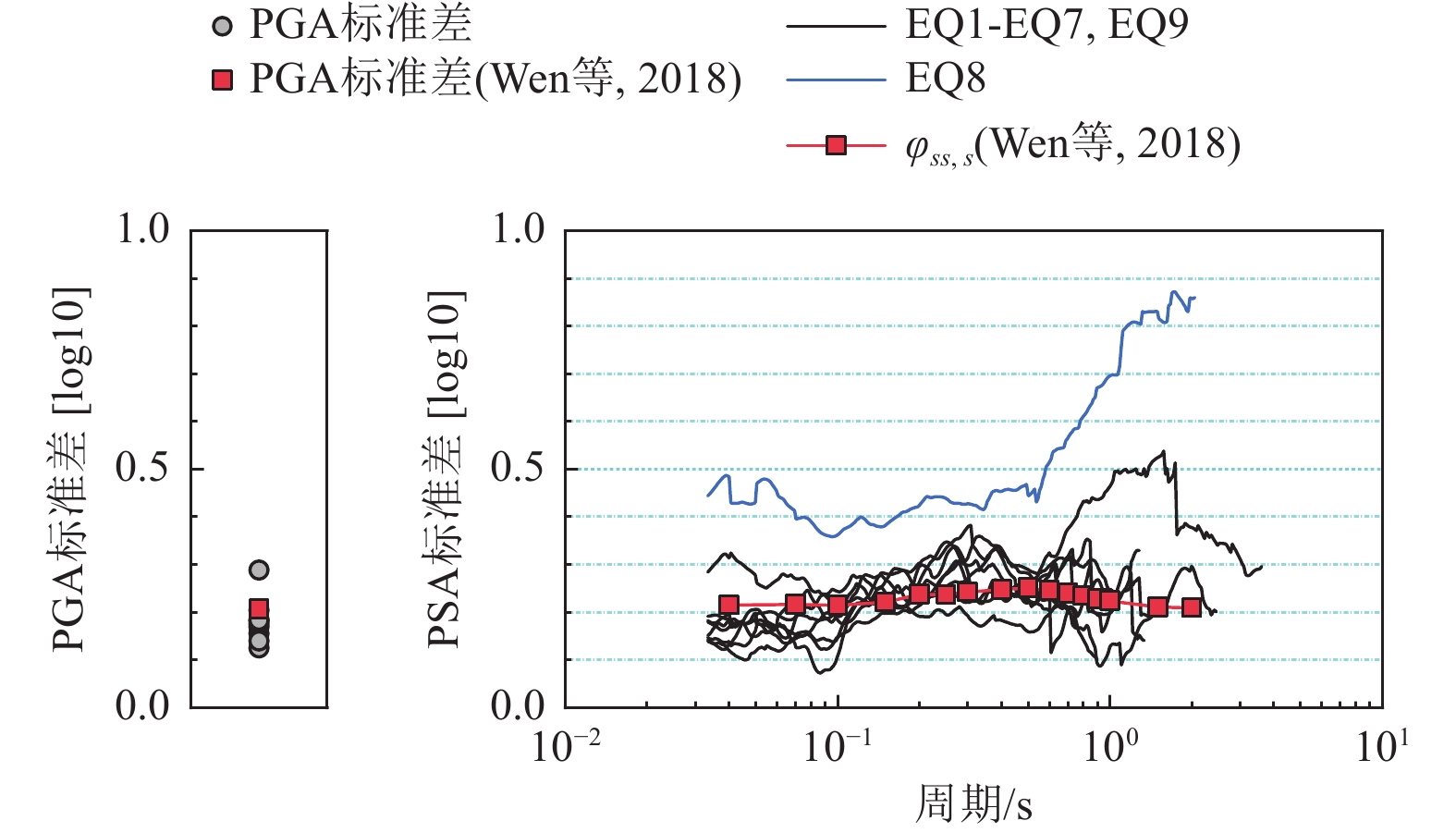
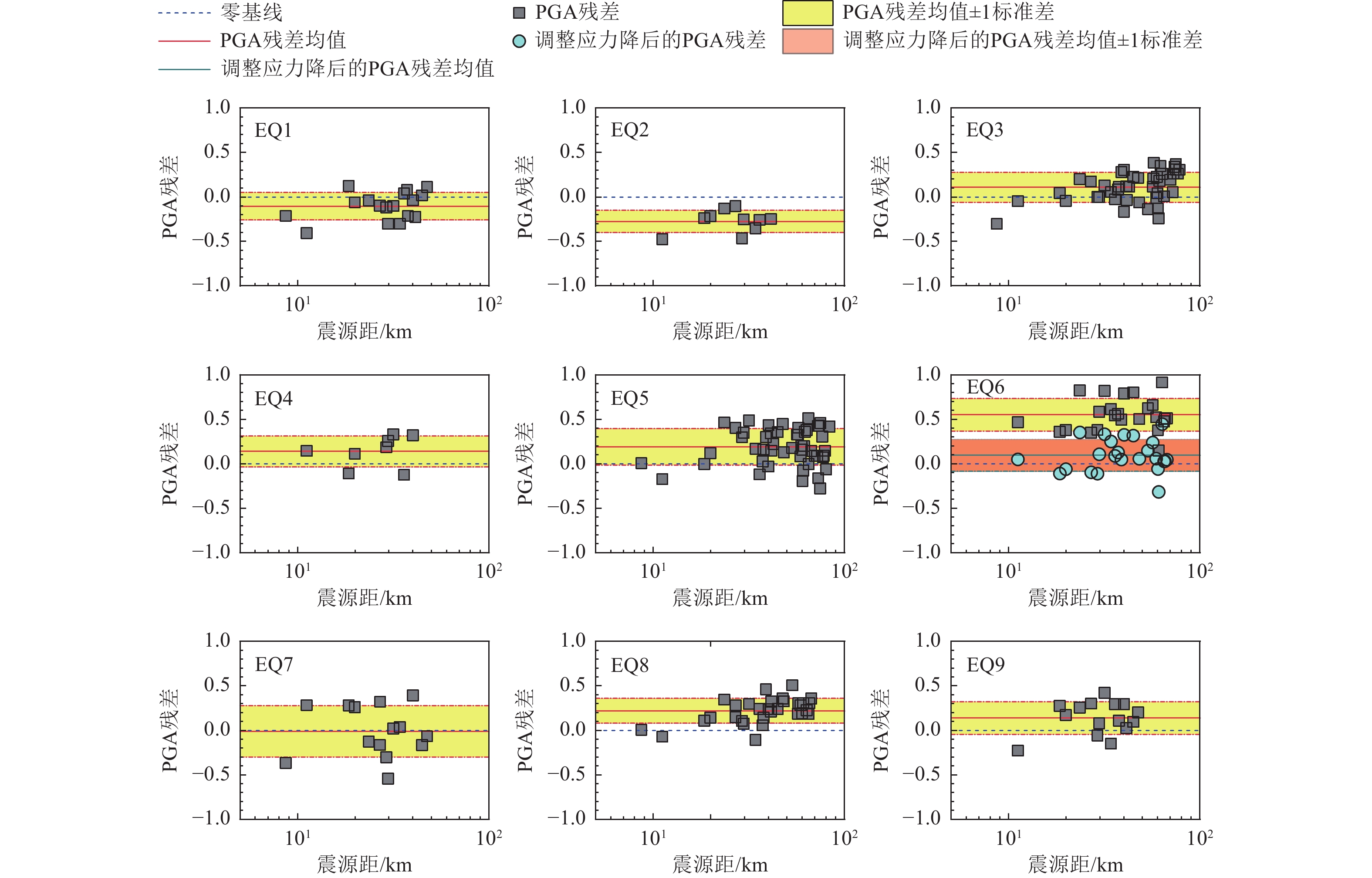
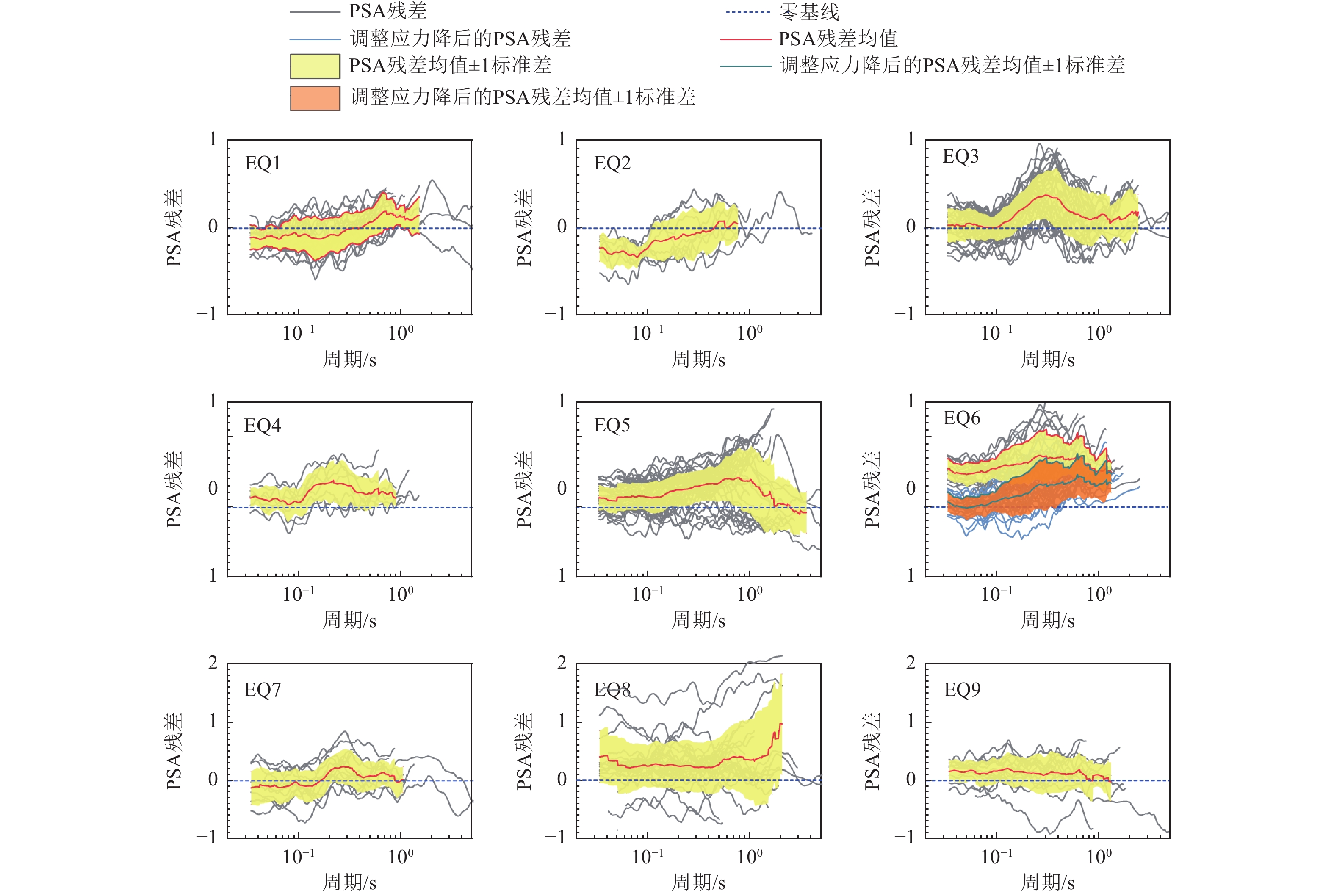
图 4 模拟记录PGA、PSA残差的标准差
Figure 4. The standard deviation of residuals of PGAs, PSAs for the simulations
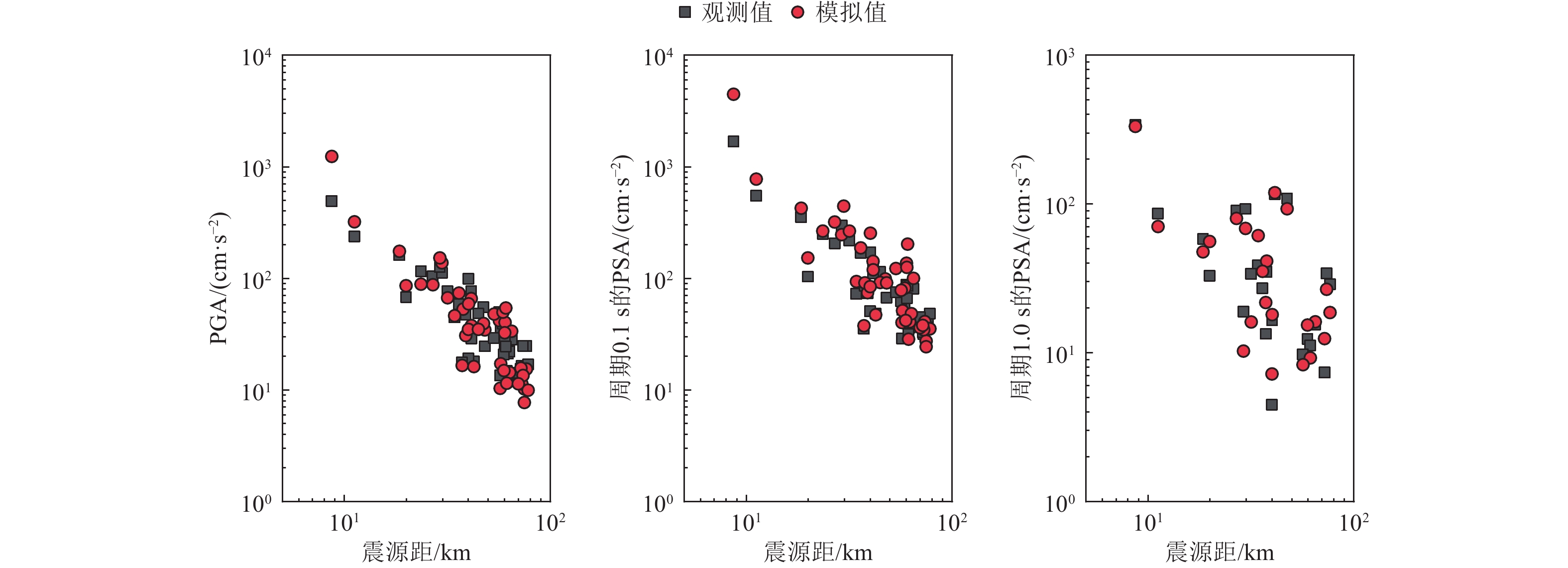
图 5 EQ3观测记录作为EGF时漾濞主震模拟记录PGA以及周期0.1 、0.3 s的PSA与观测值的对比
Figure 5. Comparisons of the PGAs and PSAs at periods of 0.1 and 0.3 s for the simulated results with observed recordings from EQ3 as EGFs with the observed ones
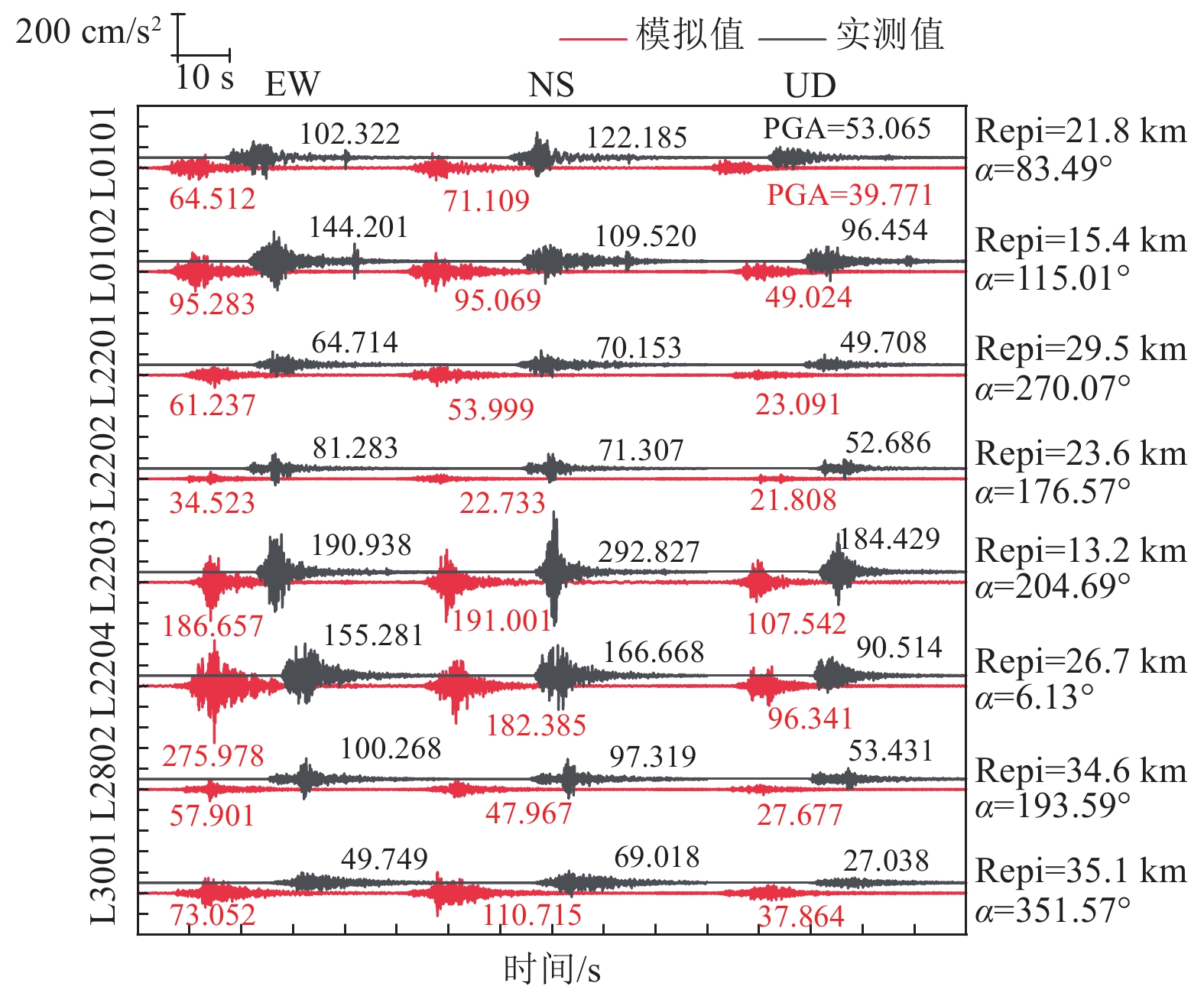
图 6 EQ4观测记录作为EGF时漾濞主震模拟记录加速度时程与观测记录的对比
Figure 6. Comparisons of the acceleration time histories for the simulations with observed recordings from EQ4 as EGFs with the observed ones
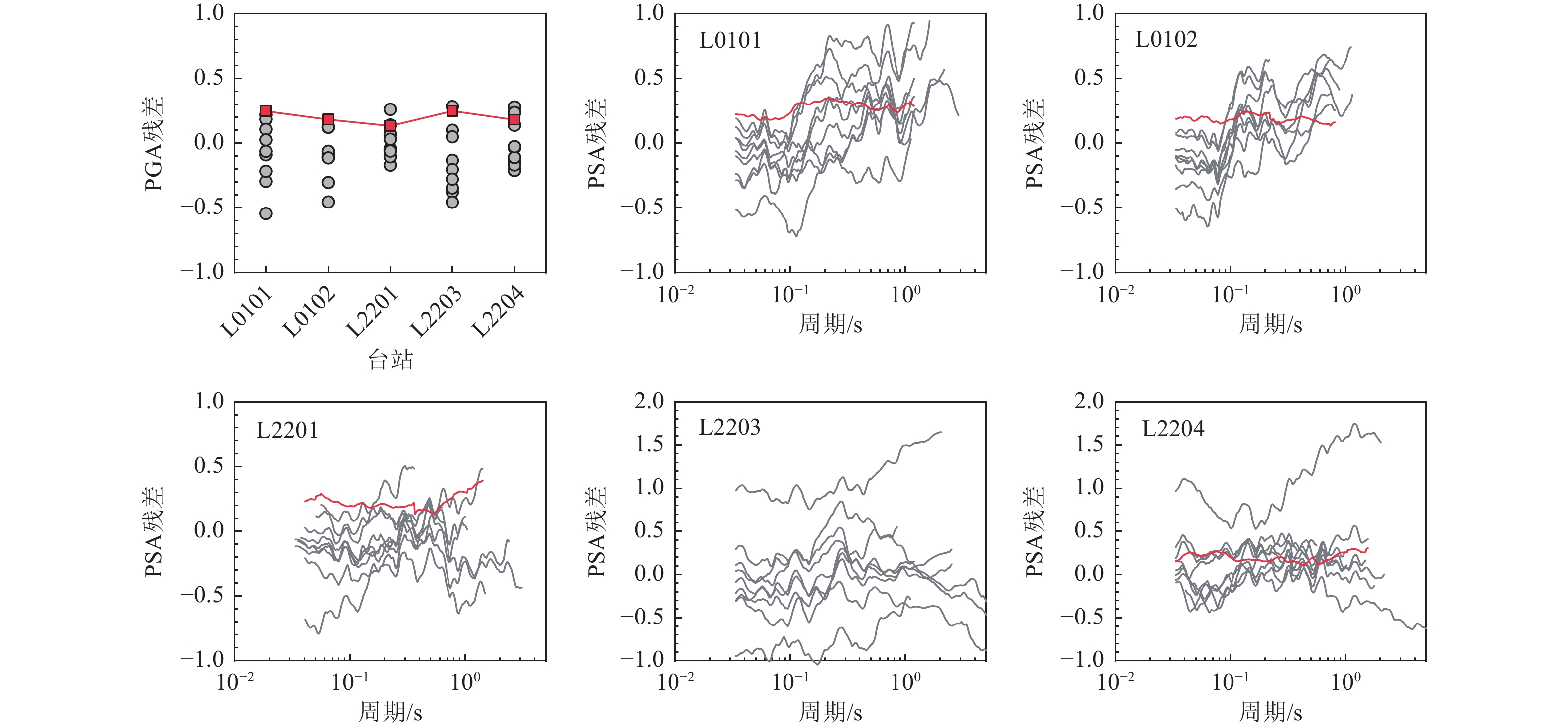
图 7 选用不同EGF给出的目标地震中同台站模拟记录PGA、PSA差异 采用物理量/单位形式表达
Figure 7. PGAs and PSAs of the simulated results at single station based on the various EGFs
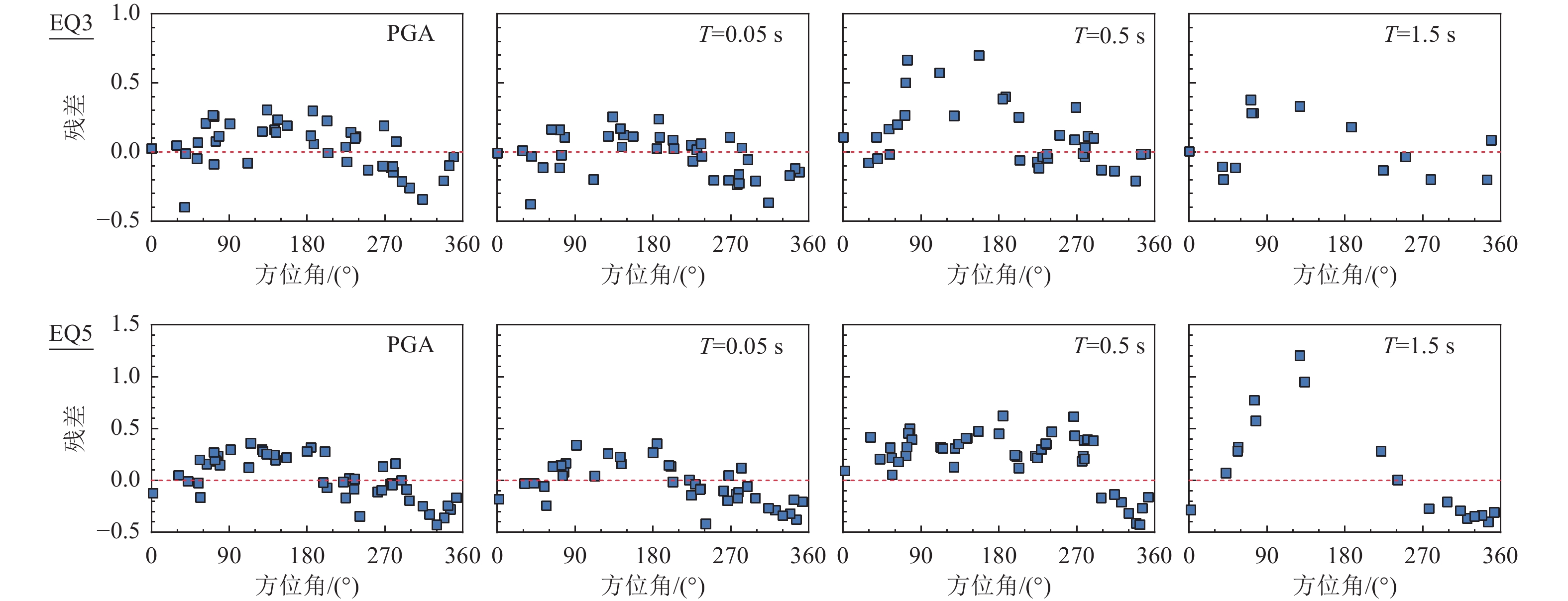
图 8 PGA和PSA残差-方位角关系图像
Figure 8. Relationship Image between PGA, PSA residuals and azimuth angle
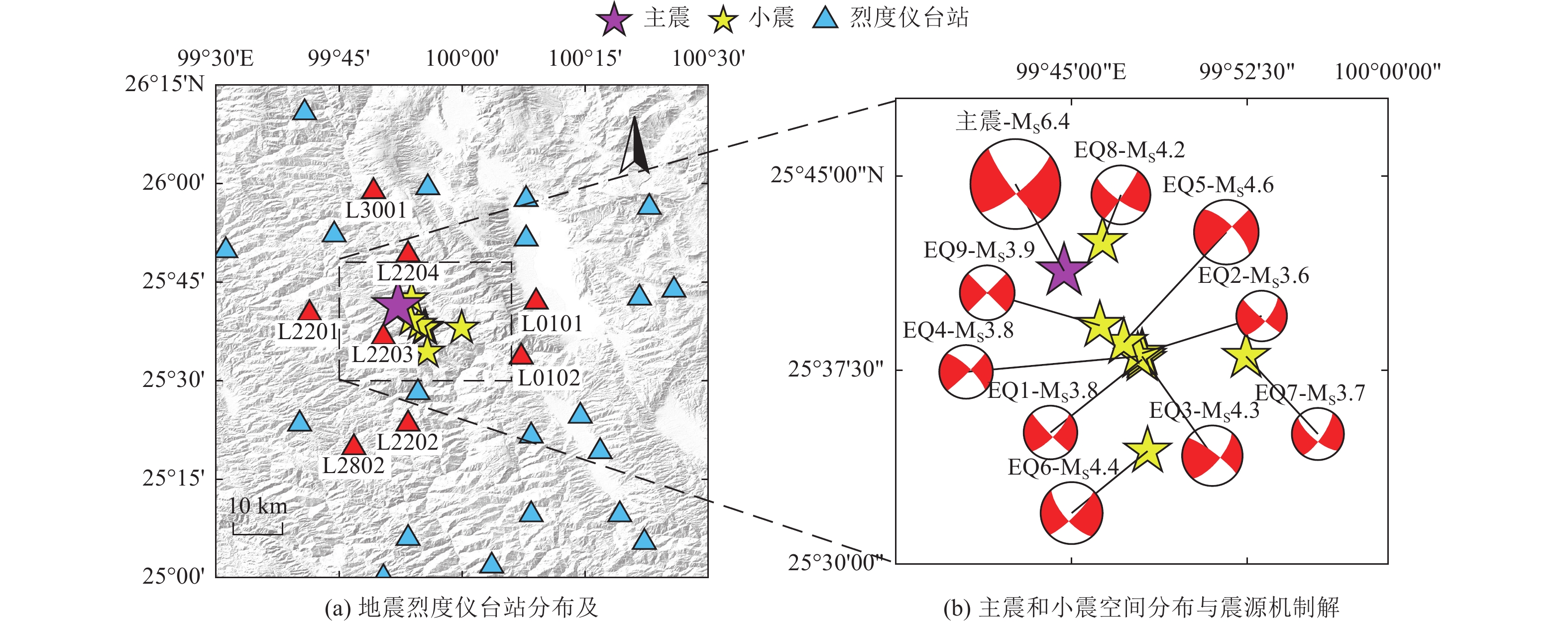
表 1 漾濞主震和小地震的基本信息
Table 1. Basic information of the mainshock and small earthquakes as EGFs in the Yangbi earthquake sequence
地震 发震时间 震级/MW 震中 震源深度/km 震源机制解 EGF数量 北纬/(°) 东经/(°) 走向/(°) 倾角/(°) 滑动角/(°) 漾濞主震 2021/05/21 6 25.689 99.869 8.8 143 80 −165 / 21:48:34 EQ1 2021/05/18 3.8 25.632 99.925 13 136 85 −165 17 18:49:30 EQ2 2021/05/18 3.6 25.636 99.925 13.3 132 85 −160 10 20:56:46 EQ3 2021/05/18 4.3 25.634 99.925 14.1 307 81 160 43 21:39:35 EQ4 2021/05/19 3.8 25.634 99.922 13.5 314 75 175 8 3:27:56 EQ5 2021/05/19 4.6 25.643 99.912 14.2 315 70 180 49 20:05:56 EQ6 2021/05/21 4.4 25.573 99.929 11.8 139 70 −169 24 22:02:00 EQ7 2021/05/21 3.7 25.634 99.999 12.7 130 71 −164 14 23:18:09 EQ8 2021/05/22 4.2 25.708 99.897 11.9 126 75 −175 31 00:51:41 EQ9 2021/05/22 3.9 25.654 99.895 13.3 315 90 180 15 17:24:16  下载: 导出CSV
-
巴振宁, 刘悦, 赵靖轩等, 2023. 2021年漾濞6.4级近断层宽频地震动模拟: 一种改进的FK方法. 岩土工程学报, 45(4): 709−719.Ba Z. N., Liu Y., Zhao J. X., et al., 2023. Near-fault broadband ground-motion simulation of 2021 Yangbi MS6.4 earthquake: an improved FK Method. Chinese Journal of Geotechnical Engineering, 45(4): 709−719. (in Chinese) 段梦乔, 赵翠萍, 周连庆等, 2021. 2021年5月21日云南漾濞MS6.4地震序列发震构造. 地球物理学报, 64(9): 3111−3125.Duan M. Q., Zhao C. P., Zhou L. Q., et al., 2021. Seismogenic structure of the 21 May 2021 MS6.4 Yunnan Yangbi earthquake sequence. Chinese Journal of Geophysics, 64(9): 3111−3125. (in Chinese) 纪志伟, 陈学良, 张波, 2022. 漾濞MS6.4地震长周期强地震动的有限差分初步模拟. 地球与行星物理论评, 53(1): 85−91. doi: 10.19975/j.dqyxx.2021-039Ji Z. W., Chen X. L., Zhang B., 2022. Preliminary finite difference simulation of long-period strong ground motions for the Yangbi MS6.4 earthquake. Reviews of Geophysics and Planetary Physics, 53(1): 85−91. (in Chinese) doi: 10.19975/j.dqyxx.2021-039 雷兴林, 王志伟, 马胜利等, 2021. 关于2021年5月滇西漾濞MS6.4地震序列特征及成因的初步研究. 地震学报, 43(3): 261−286.Lei X. L., Wang Z. W., Ma S. L., et al., 2021. A preliminary study on the characteristics and mechanism of the May 2021 MS6.4 Yangbi earthquake sequence, Yunnan, China. Acta Seismologica Sinica, 43(3): 261−286. (in Chinese) 李大虎, 丁志峰, 吴萍萍等, 2021. 2021年5月21日云南漾濞MS6.4地震震区地壳结构特征与孕震背景. 地球物理学报, 64(9): 3083−3100.Li D. H., Ding Z. F., Wu P. P., et al., 2021. The characteristics of crustal structure and seismogenic background of Yangbi MS6.4 earthquake on May 21, 2021 in Yunnan Province, China. Chinese Journal of Geophysics, 64(9): 3083−3100. (in Chinese) 李宗超, 高孟潭, 陈学良等, 2019. 九寨沟MS7.0地震强地震动模拟及漳扎镇地震动强度预测. 地球物理学报, 62(7): 2567−2581.Li Z. C., Gao M. T., Chen X. L., et al., 2019. Simulation of ground motion by the 2017 Jiuzhaigou MS7.0 earthquake and estimation of ground motion intensity in the Zhangzha Town. Chinese Journal of Geophysics, 62(7): 2567−2581. (in Chinese) 李宗超, 高孟潭, 孙吉泽等, 2022. 海域俯冲带高频地震动模拟−−以2021年2月13日日本福岛MS7.1地震为例. 震灾防御技术, 17(3): 516−528.Li Z. C., Gao M. T., Sun J. Z., et al., 2022. Simulation of high-frequency ground motions in the subduction zone of the sea area−taking the Fukushima MS7.1 earthquake on February 13, 2021 as an example. Technology for Earthquake Disaster Prevention, 17(3): 516−528. (in Chinese) 李宗超, 纪志伟, 孙吉泽等, 2025. 基于安徽合肥MS4.7地震快速估计本地区MS6.0设定地震加速度时程及其破坏能力. 地球与行星物理论评(中英文), 56(3): 338−351.Li Z. C., Ji Z. W., Sun J. Z., et al., 2025. Rapid estimation of MS6.0 scenario earthquake acceleration waveform and its destructive capacity in local area based on the MS4.7 earthquake in Anhui Province. Reviews of Geophysics and Planetary Physics, 56(3): 338−351. (in Chinese) 刘峥, 徐永林, 胡俊等, 2016. 合成的台湾MS8.0级大震在上海产生的地震动. 震灾防御技术, 11(2): 360−366.Liu Z., Xu Y. L., Hu J., et al., 2016. The estimated value of ground surface wave in Shanghai by synthesizing Taiwan MS8.0 earthquake with empirical green's function. Technology for Earthquake Disaster Prevention, 11(2): 360−366. (in Chinese) 龙锋, 祁玉萍, 易桂喜等, 2021. 2021年5月21日云南漾濞MS6.4地震序列重新定位与发震构造分析. 地球物理学报, 64(8): 2631−2646.Long F., Qi Y. P., Yi G. X., et al., 2021. Relocation of the MS6.4 Yangbi earthquake sequence on May 21, 2021 in Yunnan Province and its seismogenic structure analysis. Chinese Journal of Geophysics, 64(8): 2631−2646. (in Chinese) 强生银, 王宏伟, 温瑞智等, 2021. 2021年5月21日云南漾濞MS6.4地震随机有限断层三维地震动模拟. 地球物理学报, 64(12): 4538−4547.Qiang S. Y., Wang H. W., Wen R. Z., et al., 2021. Three-dimensional ground motion simulations by the stochastic finite-fault method for the Yangbi, Yunnan MS6.4 earthquake on May 21, 2021. Chinese Journal of Geophysics, 64(12): 4538−4547. (in Chinese) 王宏伟, 2017. 地震动模拟的两步随机经验格林函数方法研究. 哈尔滨: 中国地震局工程力学研究所.Wang H. W. , 2017. Study on the two-stage stochastic empirical green's function method for ground motion simulation. Harbin: Institute of Engineering Mechanics, China Earthquake Administration. (in Chinese) 吴浩, 入倉孝次郎, 林国良, 2023. 基于经验格林函数法的2021年MS6.4漾濞地震近场强震动模拟. 地震地质, 45(4): 864−879.Wu H., Irikura K., Lin G. L., 2023. The empirical green's function-based simulation of near-field strong ground motions of the 2021 Yangbi earthquake (MS6.4), Yunnan, China. Seismology and Geology, 45(4): 864−879. (in Chinese) 席桂梅, 郭雷, 何书耕等, 2019. 用改进的经验格林函数方法模拟唐山地震动. 震灾防御技术, 14(1): 97−107.Xi G. M., Guo L., He S. G., et al., 2019. Ground motion simulations of Tangshan with improved empirical green's function. Technology for Earthquake Disaster Prevention, 14(1): 97−107. (in Chinese) 杨九元, 温扬茂, 许才军, 2021. 2021年5月21日云南漾濞MS6.4地震: 一次破裂在隐伏断层上的浅源走滑事件. 地球物理学报, 64(9): 3101−3110.Yang J. Y., Wen Y. M., Xu C. J., 2021. The 21 May 2021 MS6.4 Yangbi (Yunnan) earthquake: a shallow strike-slip event rupturing in a blind fault. Chinese Journal of Geophysics, 64(9): 3101−3110. (in Chinese) 杨苗, 王宏伟, 温瑞智等, 2023. 2021年漾濞地震序列破裂方向性研究. 地震学报, 45(5): 836−848.Yang M., Wang H. W., Wen R. Z., et al., 2023. Study on the rupture directivity of the 2021 Yangbi earthquake sequence. Acta Seismologica Sinica, 45(5): 836−848. (in Chinese) 杨云存, 王华柳, 段毅等, 2021. 云南漾濞M6.4地震震源机制解分析. 四川地震, (4): 12−17.Yang Y. C., Wang H. L., Duan Y., et al., 2021. Focal mechanism solution of the M6.4 Yangbi earthquake in Yunnan. Earthquake Research in Sichuan, (4): 12−17. (in Chinese) 姚鑫鑫, 任叶飞, 岸田忠大等, 2025. 满足数据同一性的强震动记录去噪滤波后处理输出方法. 工程力学, 42(1): 152−163.Yao X. X., Ren Y. F., Kishida T., et al., 2025. A post processing method of strong motion record filtering satisfying the compatibility. Engineering Mechanics, 42(1): 152−163. (in Chinese) 张斌, 李小军, 林国良等, 2021. 2021年5月21日漾濞MS6.4地震近场地震动特征和方向性效应分析. 地球物理学报, 64(10): 3619−3631.Zhang B., Li X. J., Lin G. L., et al., 2021. Analysis of strong ground motion characteristics and directivity effect in the near-field for the May 21, 2021 MS6.4 Yangbi earthquake. Chinese Journal of Geophysics, 64(10): 3619−3631. (in Chinese) 赵博, 高原, 马延路, 2022. 2021年5月21日云南漾濞MS6.4地震序列重新定位、震源机制及应力场反演. 地球物理学报, 65(3): 1006−1020.Zhao B., Gao Y., Ma Y. L., 2022. Relocations, focal mechanisms and stress inversion of the May 21th 2021 Yangbi MS6.4 earthquake sequence in Yunnan, China. Chinese Journal of Geophysics, 65(3): 1006−1020. (in Chinese) Allmann B. P., Shearer P. M., 2009. Global variations of stress drop for moderate to large earthquakes. Journal of Geophysical Research: Solid Earth, 114(B1): B01310. Beauval C., Honoré L., Courboulex F., 2009. Ground-motion variability and implementation of a probabilistic–deterministic hazard method. Bulletin of the Seismological Society of America, 99(5): 2992−3002. Boyd O. S., McNamara D. E., Hartzell S., et al., 2017. Influence of lithostatic stress on earthquake stress drops in North America. Bulletin of the Seismological Society of America, 107(2): 856−868. Brune J. N., 1970. Tectonic stress and the spectra of seismic shear waves from earthquakes. Journal of Geophysical Research, 75(26): 4997−5009. Courboulex F., Converset J., Balestra J., et al., 2010. Ground-motion simulations of the 2004 Mw6.4 Les Saintes, Guadeloupe, earthquake using ten smaller events. Bulletin of the seismological Society of America, 100(1): 116−130. Denolle M. A., Shearer P. M., 2016. New perspectives on self‐similarity for shallow thrust earthquakes. Journal of Geophysical Research: Solid Earth, 121(9): 6533−6565. Eshelby J. D. , 1957. The determination of the elastic field of an ellipsoidal inclusion, and related problems. Proceedings of the Royal Society A: Mathematical, Physical and Engineering Sciences, 241(1226): 376−396. Gong W. Z., Ye L. L., Qiu Y. X., et al., 2022. Rupture directivity of the 2021 MW6.0 Yangbi, Yunnan earthquake. Journal of Geophysical Research: Solid Earth, 127(9): e2022JB024321. Irikura K., 1983. Semi-empirical estimation of strong ground motions during large earthquakes. Bulletin of the Disaster Prevention Research Institute, 33(2): 63−104. Irikura K. , Miyakoshi K. , Kamae K. , et al. , 2017. Applicability of source scaling relations for crustal earthquakes to estimation of the ground motions of the 2016 Kumamoto earthquake. Earth, Planets and Space, 69(1): 10. Joyner W. B. , Boore D. M. , 1986. On simulating large earthquakes by Green's–Function addition of smaller earthquakes. In: Das S. , Boatwright J. , Scholz C. H. , eds. , Earthquake Source Mechanics. Washington: American Geophysical Union, 269−274. Kanamori H., Anderson D. L., 1975. Theoretical basis of some empirical relations in seismology. Bulletin of the seismological society of America, 65(5): 1073−1095. Kane D. L., Kilb D. L., Vernon F. L., 2013. Selecting empirical Green’s functions in regions of fault complexity: a study of data from the San Jacinto fault zone, southern California. Bulletin of the Seismological Society of America, 103(2A): 641−650. Kohrs-Sansorny C., Courboulex F., Bour M., et al., 2005. A two-stage method for ground-motion simulation using stochastic summation of small earthquakes. Bulletin of the Seismological Society of America, 95(4): 1387−1400. Liu M., Li H. Y., Li L., et al., 2022. Multistage nucleation of the 2021 Yangbi MS 6.4 earthquake, Yunnan, China and its foreshocks. Journal of Geophysical Research: Solid Earth, 127(5): e2022JB024091. Ordaz M., Arboleda J., Singh S. K., 1995. A scheme of random summation of an empirical Green’s function to estimate ground motions from future large earthquakes. Bulletin of the Seismological Society of America, 85(6): 1635−1647. Pavic R., Koller M. G., Bard P. Y., et al., 2000. Ground motion prediction with the empirical Green's function technique: an assessment of uncertainties and confidence level. Journal of Seismology, 4(1): 59−77. Qiang S. Y., Wang H. W., Wen R. Z., et al., 2023. Characteristics of strong ground motions from four MS ≥ 5.0 earthquakes in the 2021 Yangbi, southwest China, seismic sequence. Journal of Earthquake Engineering, 27(14): 3957−3974. Salichon J., Kohrs-Sansorny C., Bertrand E., et al., 2010. A Mw 6.3 earthquake scenario in the city of Nice (southeast France): ground motion simulations. Journal of Seismology, 14(3): 523−541. Somerville P., Irikura K., Graves R., et al., 1999. characterizing crustal earthquake slip models for the prediction of strong ground motion. Seismological Research Letters, 70(1): 59−80. Wang H. W., Wen R. Z., Ren Y. F., 2017. Simulating ground‐motion directivity using stochastic empirical green's function method. Bulletin of the Seismological Society of America, 107(1): 359−371. Wang H. W., Ren Y. F., Wen R. Z., et al., 2019. Investigating the contribution of stress drop to ground-motion variability by simulations using the stochastic empirical Green’s function method. Pure and Applied Geophysics, 176(10): 4415−4430. Wen R. Z., Xu P. B., Wang H. W., et al., 2018. Single‐station standard deviation using strong-motion data from Sichuan region, China. Bulletin of the Seismological Society of America, 108(4): 2237−2247. Wennerberg L., 1990. Stochastic summation of empirical Green’s functions. Bulletin of the Seismological Society of America, 80(6A): 1418−1432. Zhou Y. J., Ren C. M., Ghosh A., et al., 2022. Seismological characterization of the 2021 Yangbi foreshock-mainshock sequence, Yunnan, China: more than a triggered cascade. Journal of Geophysical Research: Solid Earth, 127(8): e2022JB024534. -

 点击查看大图
计量
- 文章访问数: 104
- HTML全文浏览量: 7
- PDF下载量: 154
- 被引次数: 0
