


Stochastic Modeling and Reconstruction Method for Multi-Directional Long-Period Ground Motions
-
摘要: 长周期地震动中显著的低频成分对复杂、大型柔性结构的动力响应有着不可忽视的影响。因此,合理地随机建模长周期地震动是进行大型柔性结构抗震分析与设计的关键。然而,现有的模型未能充分考虑长周期地震动的多维性,并且缺乏与规范一致的推荐参数值。为了应对这一挑战,本研究提出了一种方法,基于实测地震动数据,采用经验模态分解(EMD)技术,将长周期地震动分解为高频和低频成分,以便独立研究其频谱特性。这一方法为理解长周期地震动复杂的频谱特性奠定了基础。接着,本文初步识别并统计分析了高低频成分的演化功率谱密度(EPSD)函数参数,进一步揭示了长周期地震动的频谱特性及其变化规律。在此基础上,利用本征正交分解(POD)方法,分别模拟了不同方向的高频和低频成分样本,并重构了三维长周期地震动过程。数值算例与验证结果显示,所生成的代表性样本能够真实反映长周期、三维地震动的动力学特征,具有较高的工程准确性与实用性。本研究提出的长周期地震动随机模型不仅能够有效捕捉地震动的低频特征,初步探索了对长周期地震动工程特征随机建模,还为后续的精细化研究提供了坚实的理论依据和技术支撑。Abstract: The significant low-frequency components in long-period ground motions have a non-negligible impact on the dynamic response of complex, large-scale flexible structures. Therefore, a reasonable stochastic modeling of long-period ground motions is a key foundation for the seismic analysis and design of large flexible structures. To address this issue, this study proposes an exploratory approach, based on measured seismic data, employing the Empirical Mode Decomposition (EMD) method to decompose long-period ground motions into high-frequency and low-frequency components, thereby separating and studying their spectral composition, which lays the foundation for revealing the complex spectral characteristics of long-period ground motions. Subsequently, a preliminary identification and statistical analysis of the evolution of the power spectral density (EPSD) function parameters for the high- and low-frequency components are conducted, further revealing the spectral characteristics and their variations of long-period ground motions. Based on this, the Proper Orthogonal Decomposition (POD) method is used to simulate the samples of high- and low-frequency components in different directions, and to reconstruct the three-dimensional long-period ground motion process. Numerical examples and validation results show that the generated representative samples can accurately reflect the dynamic characteristics of long-period, three-dimensional ground motions, with high engineering accuracy and practicality. The proposed stochastic model for long-period ground motions not only effectively captures the low-frequency characteristics of ground motions but also realizes the preliminary exploration of stochastic modeling for the engineering features of long-period ground motions, providing a reliable theoretical basis and technical support for future refined research.
-
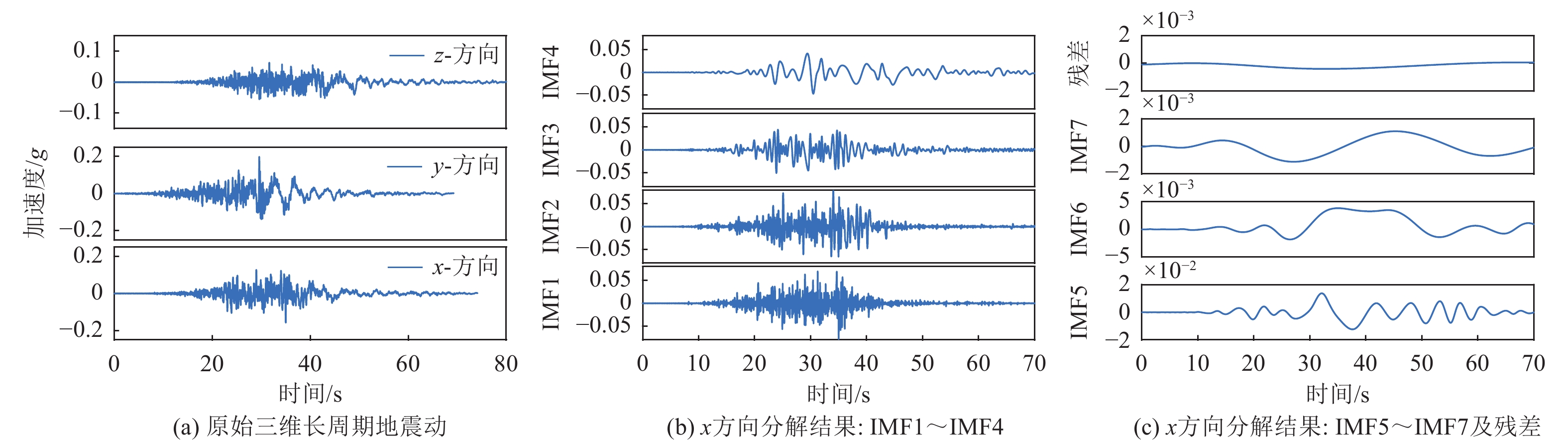
图 2 TCU029站记录的Chi-Chi地震时程
Figure 2. The time history of Chi-Chi earthquake measured by station TCU029
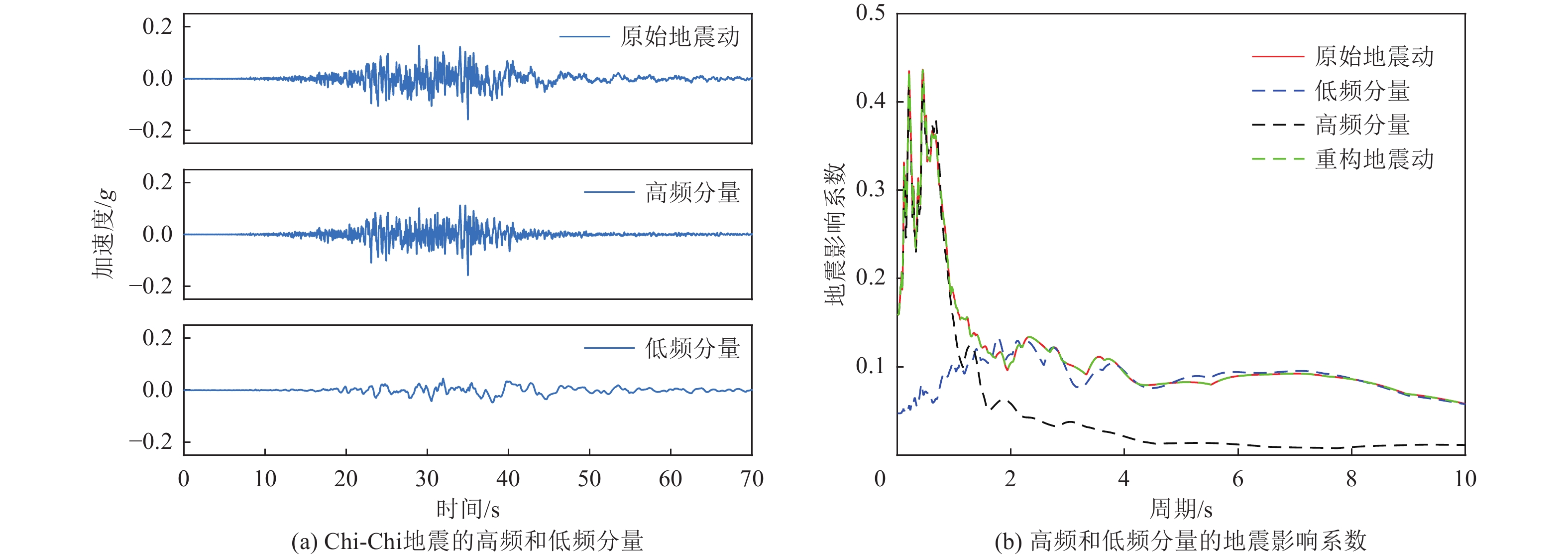
图 3 Chi-Chi地震动x方向的IMFs及相应的地震影响系数
Figure 3. The IMFs of Chi-Chi earthquake in x-direction and corresponding seismic influence coefficient
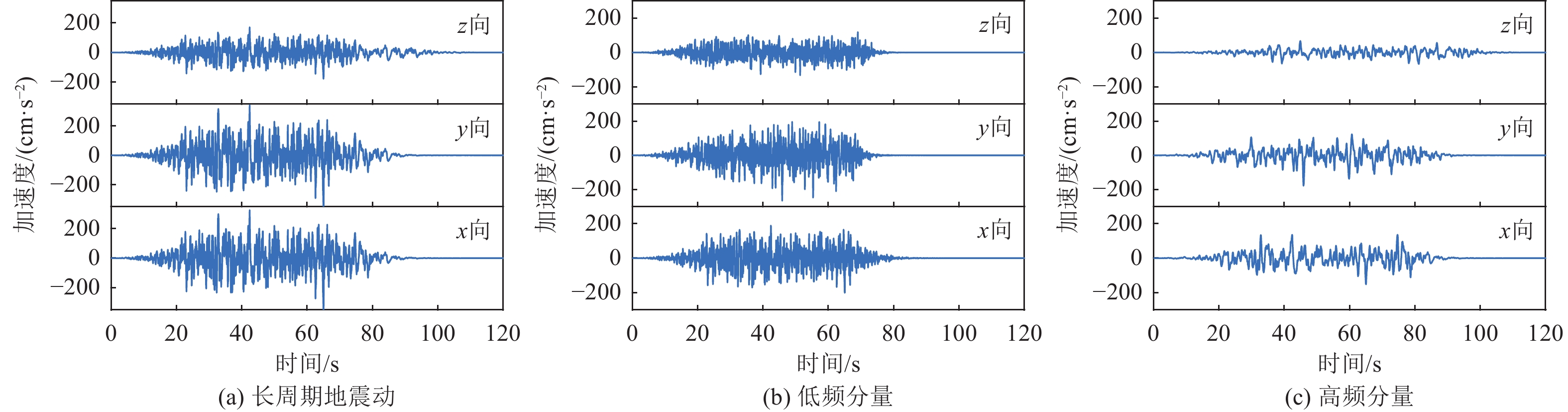
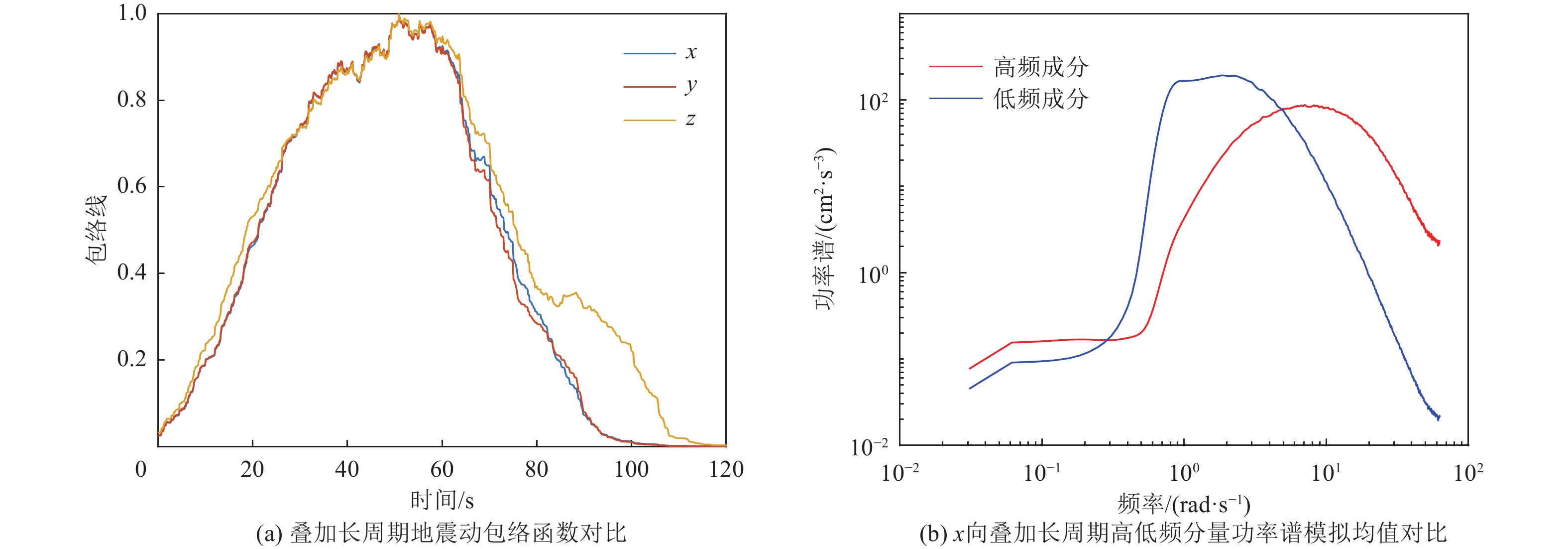
图 6 三维长周期地震动过程的代表性样本
Figure 6. Representative samples of simulated multi-direction long-period ground motion process
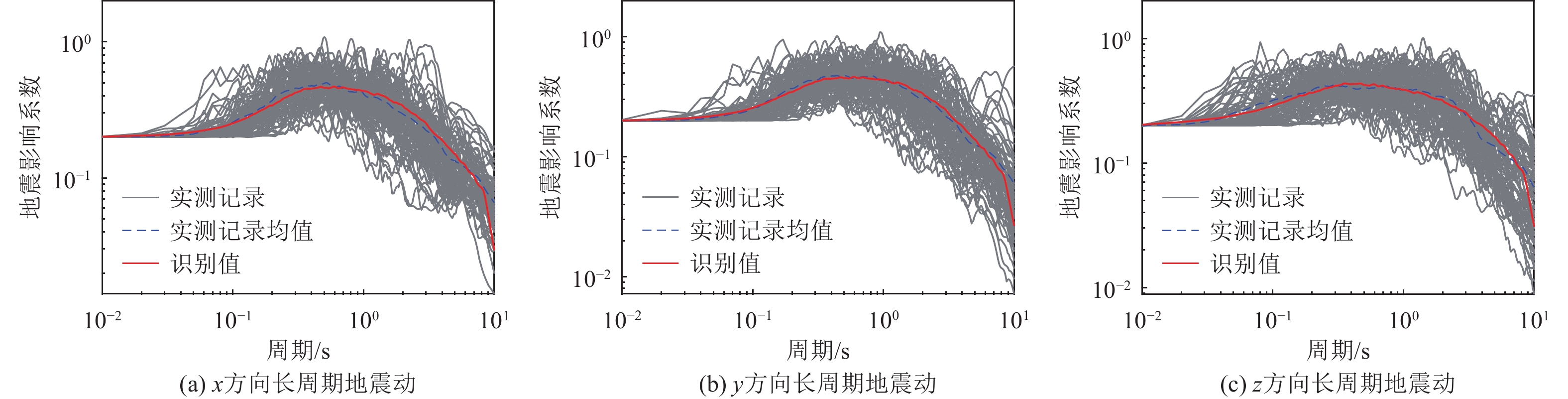
图 8 模拟地震影响系数均值与场地类型2实测地震影响系数均值的对比(样本数:100)
Figure 8. Comparisons between the mean value of simulated seismic influence coefficient and the mean value of recorded seismic influence coefficient in site 2 (the number of samples: 100)
表 1 各场地条件对应的长周期地震动
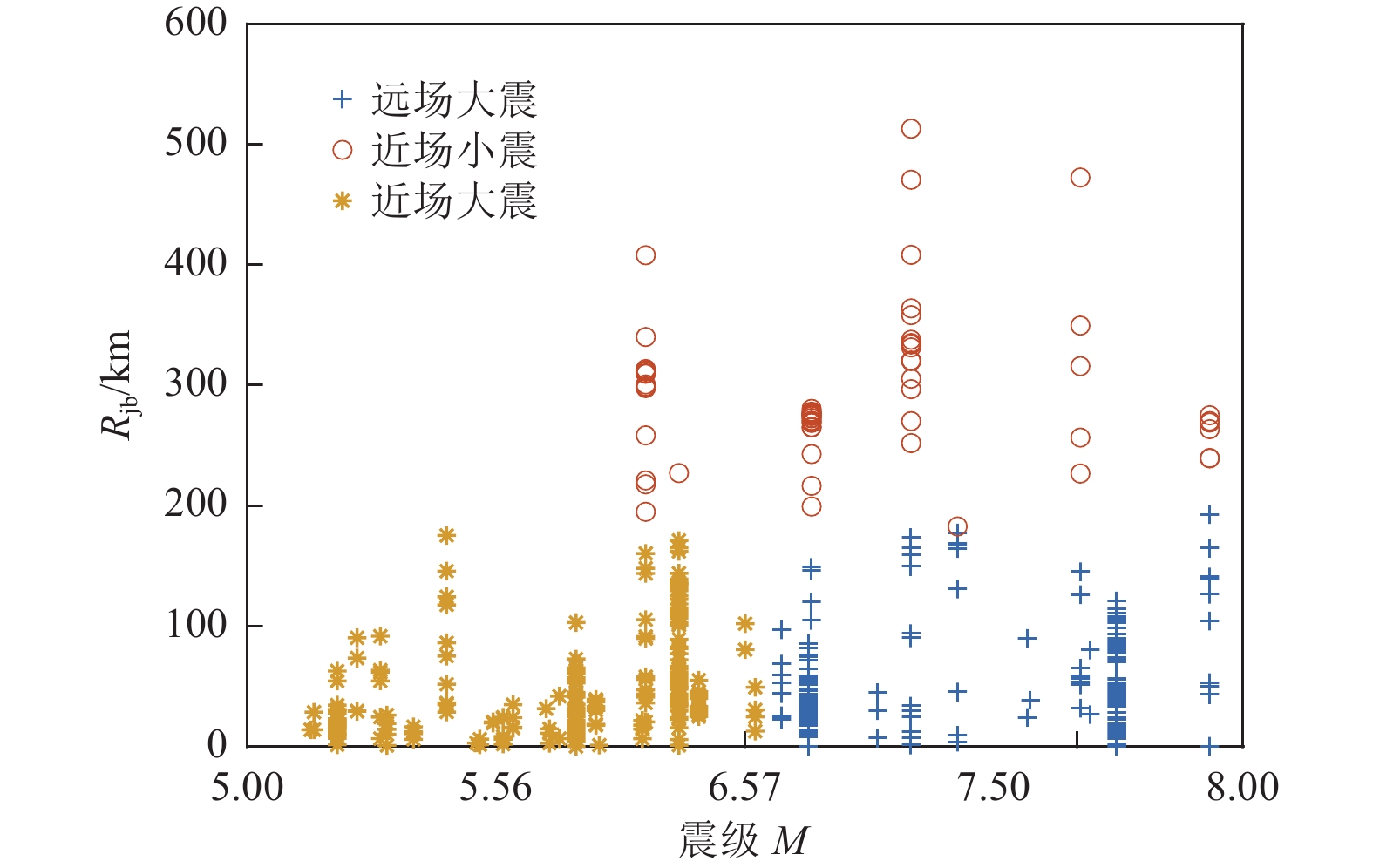
Table 1. The number of selected measured far-filed long-period ground motion records correspondence between site classes and $ {V}_{\text{S30}} $
实测记录 场地分类 1 2 3 $ {V}_{\text{S30}} $/(m·s−1) >450 300~450 <300 数量/条 93 72 130  下载: 导出CSV
表 2 长周期地震动的推荐EPSD参数
Table 2. The recommended EPSD parameters of long-period ground motions
场地类型 频率成分 方向 参数 t1/s (t1−t2)/s $ \alpha $ $ \omega_{\text{g},i}^u /(\text{rad}\cdot\text{s}^{-1}) $ $ \xi_{\text{g},i}^u $ $ D_i^u/\mathrm{s} $ $ {\omega }_{0}^u/(\text{rad}\cdot {\text{s}}^{-1}) $ 1 高频 x 26.57 66.98 0.51 28.68 0.74 0.16 3.87 y 25.73 65.61 0.51 27.79 0.80 0.14 3.30 z 21.61 63.10 0.45 57.71 0.77 0.13 3.34 低频 x 29.41 72.46 0.17 0.67 0.30 0.20 3.31 y 30.28 71.67 0.13 0.61 0.31 0.27 3.66 z 29.84 76.30 0.41 0.72 0.35 0.18 2.79 2 高频 x 26.86 67.73 0.20 20.52 0.85 0.08 2.03 y 26.29 67.79 0.37 24.10 0.82 0.09 1.89 z 22.89 71.26 0.41 43.60 0.93 0.007 1.47 低频 x 30.51 78.90 0.21 0.52 0.38 0.17 2.57 y 31.41 80.48 0.24 0.49 0.39 0.17 2.74 z 37.29 94.97 0.23 0.24 0.38 0.14 2.16 3 高频 x 22.95 63.00 0.46 10.86 0.99 0.04 2.03 y 23.06 62.60 0.46 15.51 0.78 0.03 0.74 z 19.26 58.76 0.40 72.04 0.83 0.05 1.97 低频 x 25.99 78.04 0.40 0.85 0.42 0.22 3.09 y 25.28 77.34 0.41 0.83 0.39 0.26 3.56 z 30.91 89.33 0.41 1.64 0.83 0.1 0.76
下载: 导出CSV
表 3 x方向高频和低频分量幅值参数的平均比值
Table 3. Average ratio of amplitude parameter between high and low frequency components in x-direction
场地类型 参数 $ a_{\max ,1}^{}/a_{\max ,2}^{} $ $ {\bar{r}}_{1}/{\bar{r}}_{2} $ 1 1.2242 1.1888 2 1.9203 1.2727 3 1.3303 1.0816
下载: 导出CSV
表 4 不同方向高频与低频分量幅值参数的平均比值
Table 4. Average ratio of amplitude parameter of high and low frequency components between different directions
参数 场地类型 频率分量 方向 x/y x/z amax 1 1 1.03 1.76 2 0.99 1.63 2 1 0.99 1.93 2 0.94 1.81 3 1 0.97 1.66 2 1.01 2.10 $ \bar{r} $ 1 1 0.96 0.91 2 0.99 1.01 2 1 1.00 0.89 2 1.00 1.04 3 1 0.98 0.93 2 0.98 1.06
下载: 导出CSV
表 5 模拟参数
Table 5. The parameters for simulation parameters for POD
参数 取值 上限截止频率 /(rad·s−1) $ {\omega }_{\text{u}}=240 $ 下限截止频率 /(rad·s−1) $ {\omega }_{\text{l}}=0.628 $ 频率步长/( rad·s−1) $ \Delta \omega =\text{0.14}9 $ 频率点数 $ N=1600 $ 模拟持时/s $ T=120 $ 时间步长/s $ \Delta t=\text{0.02} $ 总时间点 $ {N}_{t}=5000 $ 样本数 100
下载: 导出CSV
-
陈清军, 李英成, 2012. 基于演变谱和正交化HHT法的类谐和长周期地震动合成. 湖南大学学报(自然科学版), 39(11): 20−27. doi: 10.3969/j.issn.1674-2974.2012.11.004Chen Q. J., Li Y. C., 2012. Simulation of harmonic-like long-period ground motion based on evolutionary spectra and orthogonal HHT method. Journal of Hunan University (Natural Sciences), 39(11): 20−27. (in Chinese) doi: 10.3969/j.issn.1674-2974.2012.11.004 戴明辉, 2020. 远场长周期地震动量化识别与模拟. 重庆: 重庆大学.Dai M. H., 2020. Quantitative identification and simulation of far-field long-period ground motions. Chongqing: Chongqing University. (in Chinese) 杜修力, 陈厚群, 1994. 地震动随机模拟及其参数确定方法. 地震工程与工程振动, (4): 1−5. doi: 10.13197/j.eeev.1994.04.001Du X. L., Chen H. Q., 1994. Random simulation and its parameter determination method of earthquake ground motion. Earthquake Engineering and Engineering Vibration, (4): 1−5. (in Chinese) doi: 10.13197/j.eeev.1994.04.001 李雪红, 王文科, 吴迪等, 2014. 长周期地震动的特性分析及界定方法研究. 振动工程学报, 27(5): 685−692. doi: 10.3969/j.issn.1004-4523.2014.05.006Li X. H., Wang W. K., Wu D., et al., 2014. The bounded method and characteristics analysis for long-period ground motions. Journal of Vibration Engineering, 27(5): 685−692. (in Chinese) doi: 10.3969/j.issn.1004-4523.2014.05.006 刘章军, 姜云木, 刘子心等, 2022. 基于强震记录的多维地震动降维建模. 振动与冲击, 41(18): 244−251.Liu Z. J., Jiang Y. M., Liu Z. X., et al., 2022. Dimension-reduction simulation of multi-dimensional ground motions based on strong motion records. Journal of Vibration and Shock, 41(18): 244−251. (in Chinese) 薛俊伟, 刘伟庆, 王曙光等, 2013. 基于场地效应的地震动特性研究. 地震工程与工程振动, 33(1): 16−23. doi: 10.13197/j.eeev.2013.01.002Xue J. W., Liu W. Q., Wang S. G., et al., 2013. Research on ground motion characteristics considering site conditions. Earthquake Engineering and Engineering Dynamics, 33(1): 16−23. (in Chinese) doi: 10.13197/j.eeev.2013.01.002 Aagaard B. T., Graves R. W., Rodgers A., et al., 2010. Ground-motion modeling of Hayward fault scenario earthquakes, Part II: simulation of long-period and broadband ground motions. Bulletin of the Seismological Society of America, 100(6): 2945−2977. doi: 10.1785/0120090379 Amin M., Ang A. H. S., 1968. Nonstationary stochastic models of earthquake motions. Journal of the Engineering Mechanics Division, 94(2): 559−584. doi: 10.1061/jmcea3.0000969 Arias A. , 1970. A measure of earthquake intensity. In: Hansen R. J. , ed. , Seismic Design for Nuclear Power Plants. Cambridge: The MIT Press, 438−483. Chung Y. L., Nagae T., Hitaka T., et al., 2010. Seismic resistance capacity of high-rise buildings subjected to long-period ground motions: E-Defense shaking table test. Journal of Structural Engineering, 136(6): 637−644. doi: 10.1061/(ASCE)ST.1943-541X.0000161 Chung Y. L., Nagae T., Matsumiya T., et al., 2011. Seismic resistance capacity of beam–column connections in high-rise buildings: E-Defense shaking table test. Earthquake Engineering & Structural Dynamics, 40(6): 605−622. doi: 10.1002/eqe.1037 Chung Y. L., Nagae T., Matsumiya T., et al., 2012. Seismic capacity of retrofitted beam–column connections in high-rise steel frames when subjected to long-period ground motions. Earthquake Engineering & Structural Dynamics, 41(4): 735−753. doi: 10.1002/eqe.1154 Deodatis G., 1996. Non-stationary stochastic vector processes: seismic ground motion applications. Probabilistic Engineering Mechanics, 11(3): 149−167. doi: 10.1016/0266-8920(96)00007-0 Di Paola M., Pisano A. A., 1996. Multivariate stochastic wave generation. Applied Ocean Research, 18(6): 361−365. doi: 10.1016/S0141-1187(97)00003-5 Huang N. E. , Shen Z. , Long S. R. , et al. , 1998. The empirical mode decomposition and the Hilbert spectrum for nonlinear and non-stationary time series analysis. Proceedings of the Royal Society A: Mathematical, Physical and Engineering Sciences, 454(1971): 903−995. Li Y. N., Wang G. X., 2016. Simulation and generation of spectrum-compatible ground motions based on wavelet packet method. Soil Dynamics and Earthquake Engineering, 87: 44−51. doi: 10.1016/j.soildyn.2016.04.008 Maeda T., Sasatani T., 2008. Long-period ground motions from the 2003 Tokachi-oki earthquake. Journal of Seismology, 12(2): 243−253. doi: 10.1007/s10950-007-9076-9 Novikova E. I., Trifunac M. D., 1994. Duration of strong ground motion in terms of earthquake magnitude, epicentral distance, site conditions and site geometry. Earthquake Engineering & Structural Dynamics, 23(9): 1023−1043. doi: 10.1002/eqe.4290230907 Oana A., Kitamura H., Yoshie K., et al., 2012. Qualitative evaluation of f-values of long-period ground motions for design earthquake motions. Journal of Structural and Construction Engineering, 77(674): 575−584. Priestley M. B., 1965. Evolutionary spectra and non-stationary processes. Journal of the Royal Statistical Society: Series B (Methodological), 27(2): 204−229. Rudin W., 1959. Some theorems on Fourier coefficients. Proceedings of the American Mathematical Society, 10(6): 855−859. doi: 10.1090/S0002-9939-1959-0116184-5 Viens L., Miyake H., Koketsu K., 2016. Simulations of long-period ground motions from a large earthquake using finite rupture modeling and the ambient seismic field. Journal of Geophysical Research: Solid Earth, 121(12): 8774−8791. doi: 10.1002/2016JB013466 Yamada N. , Iwata T. , 2005. Long-period ground motion simulation in the Kinki area during the MJ 7.1 foreshock of the 2004 off the Kii peninsula earthquakes. Earth, Planets and Space, 57(3): 197−202. Yamamoto Y., Baker J. W., 2013. Stochastic model for earthquake ground motion using wavelet packets. Bulletin of the Seismological Society of America, 103(6): 3044−3056. Yang D. X., Wang W., 2012. Nonlocal period parameters of frequency content characterization for near-fault ground motions. Earthquake Engineering & Structural Dynamics, 41(13): 1793−1811. doi: 10.1002/eqe.2157 Yang D. X., Zhou J. L., 2015. A stochastic model and synthesis for near-fault impulsive ground motions. Earthquake Engineering & Structural Dynamics, 44(2): 243−264. doi: 10.1002/eqe.2468 -

 点击查看大图
计量
- 文章访问数: 158
- HTML全文浏览量: 74
- PDF下载量: 172
- 被引次数: 0
