


Probabilistic Assessment of Seismic Risk of Bridge Retrofit with BRB Based on Cloud Diagraph Method
-
摘要: 排架墩在中小跨径公路桥梁和城市高架桥中应用广泛,历次破坏性地震中也暴露出了其显著的震害问题。为了提升排架墩桥梁的整体抗震能力,本研究采用防屈曲支撑(Buckling-Restrained Braces, BRB)作为保险丝构件,以实现对排架墩的地震损伤控制。选取一座典型的五跨连续梁桥作为研究对象,对4组不同排架墩进行基于位移的抗震性能提升设计,并使用OpenSees软件建立全桥动力分析模型。选取特定的地震动记录,以桥墩位移延性系数和支座剪应变为损伤指标,通过云图法对安装BRB前后桥梁进行概率地震需求分析,对比其概率地震需求模型、易损性曲线和危险性曲线,重点研究关键承重构件的易损性曲面随初始刚度比和屈服位移比的变化情况。结果表明,安装BRB后,各个桥墩的损伤得到了明显控制,且初始刚度比和屈服位移比对损伤控制起到了关键作用。同时,安装BRB对各个支座的损伤也产生了一定影响,在轻微损伤状态下,其影响不大,但在完全破坏状态下则存在明显差异。在相同损伤状态下,桥墩的地震损伤超越概率随初始刚度比的增加而减少,且随屈服位移比的增加而下降,并逐渐趋于稳定。Abstract: Bridge bents are widely used in urban viaducts and small-to medium-span highway bridges. However, severe damage to these structures has frequently been observed in recent major earthquakes. Buckling-restrained braces (BRBs) can serve as fuse members to control seismic damage in bridge bents and improve the seismic performance of the entire bridge system supported by them. In this study, a displacement-based seismic design method is adopted to improve the seismic performance of four sets of bridge bents in a standard five-span continuous girder bridge. A dynamic analysis model of the entire bridge is established in OpenSees, and nonlinear time-history analyses are conducted under a suite of ground motions. The displacement ductility factor of the bridge bents and the shear strain of the bearings are selected as damage indices, and the cloud method is used to carry out a probabilistic seismic demand analysis of the bridge before and after BRB retrofitting. The probabilistic seismic demand models, fragility curves, and hazard curves are compared, with particular attention given to the variation of fragility surfaces of the key load-bearing members with the initial stiffness ratio and yield displacement ratio. The results show that the damage to each bridge bent is effectively controlled after the incorporation of BRBs, and that the initial stiffness ratio and yield displacement ratio play important roles in the control effect. Meanwhile, BRB installation also affects the damage to the bearings. The difference in this effect is not significant under the slight damage state, but becomes considerable under the complete damage state. Under the same damage state, the exceedance probability of seismic damage in bridge bents decreases as the initial stiffness ratio and yield displacement ratio increase.
-
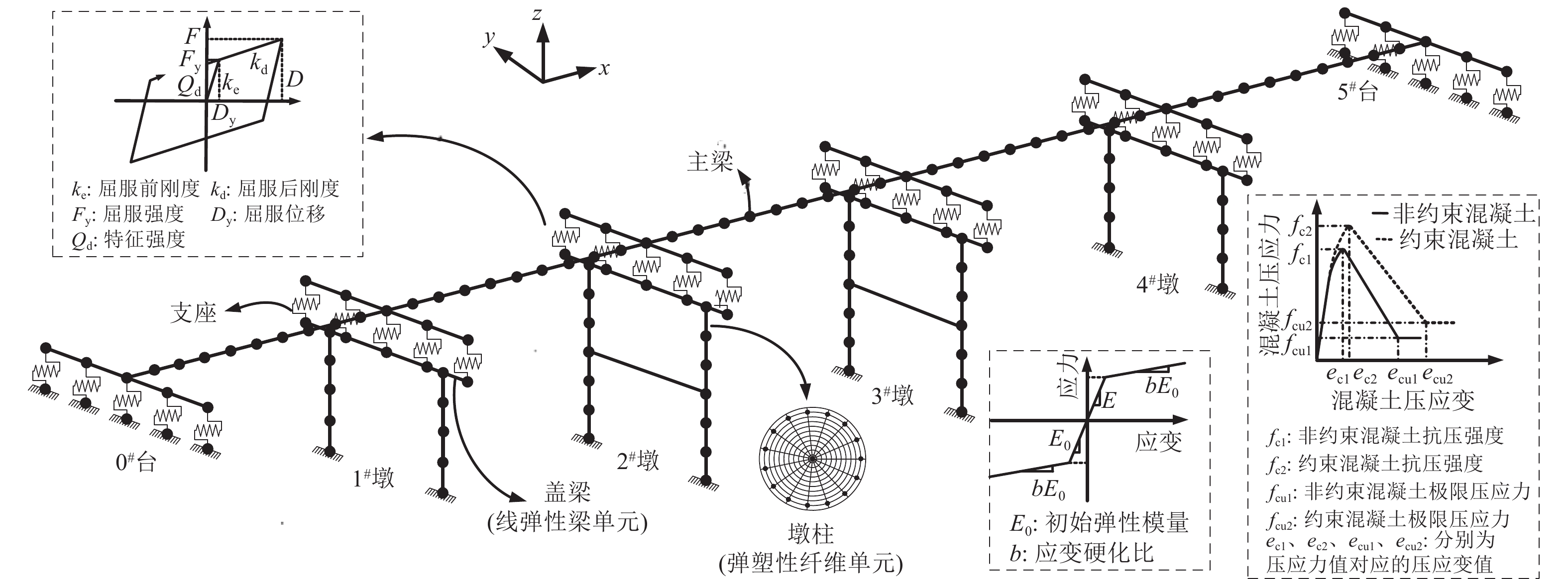
图 1 全桥动力分析有限元模型
Figure 1. Finite element model for dynamic analysis of the entire bridge
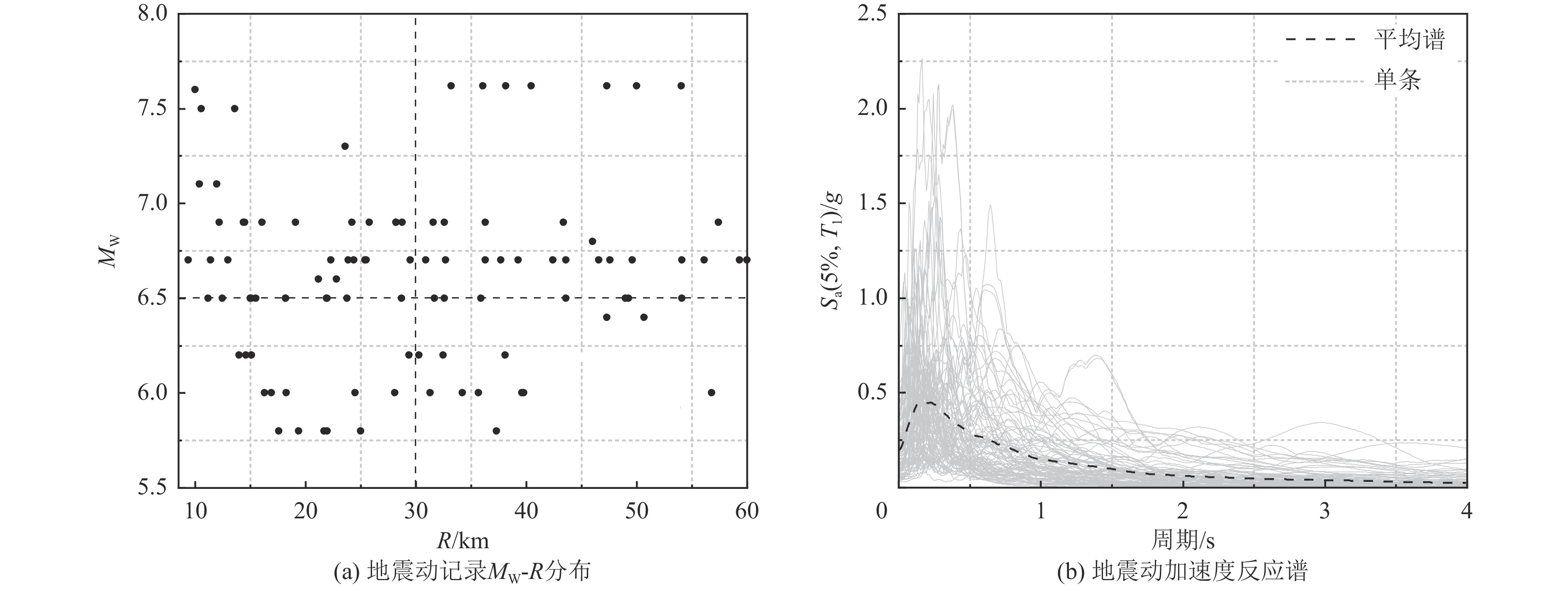
图 3 选取地震动记录MW-R分布和反应谱
Figure 3. Distribution of selected ground motion records (MW-R) and response spectra
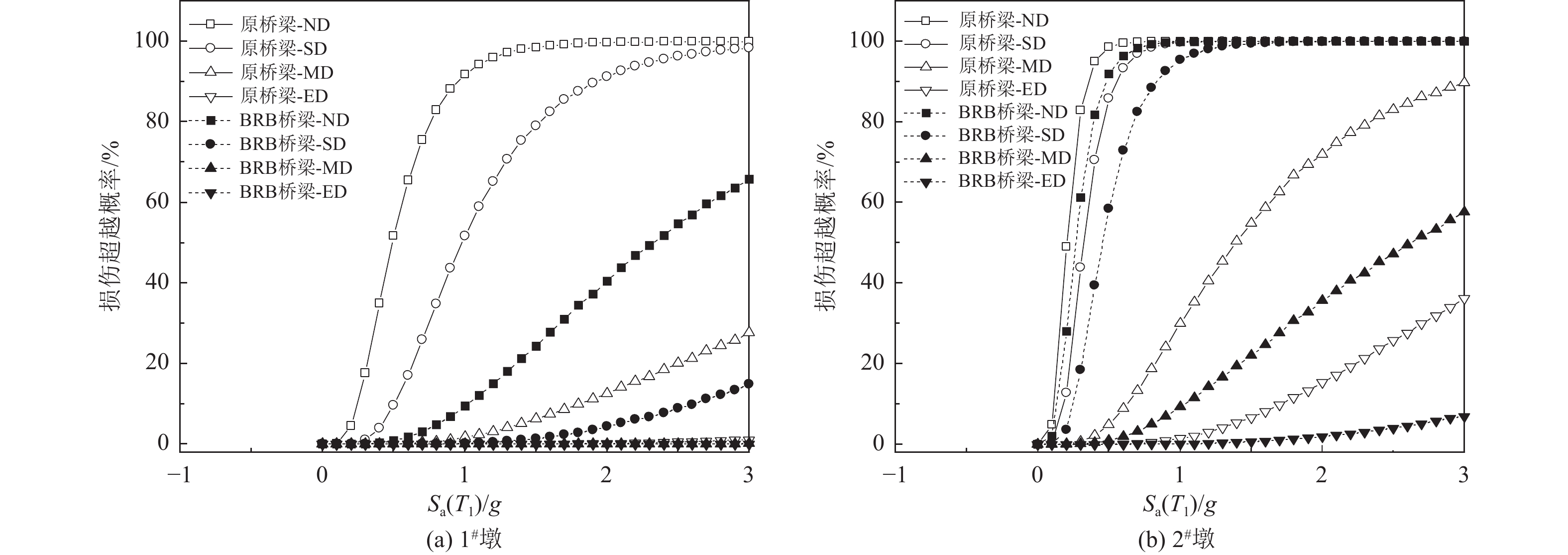
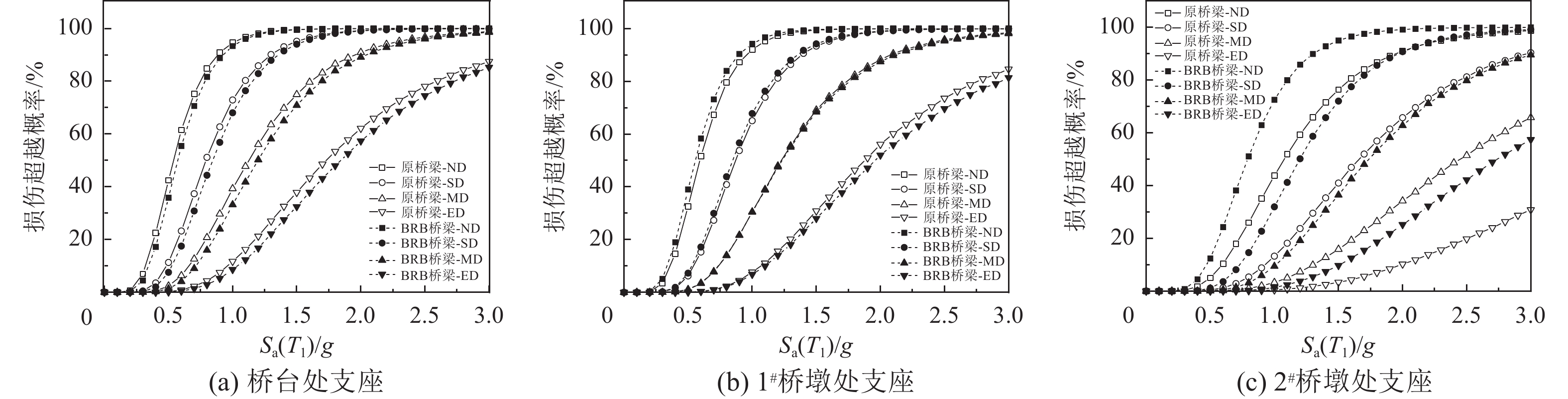
图 5 设置BRB与否桥墩易损性曲线对比
Figure 5. Comparison of bents fragility curves with and without BRB
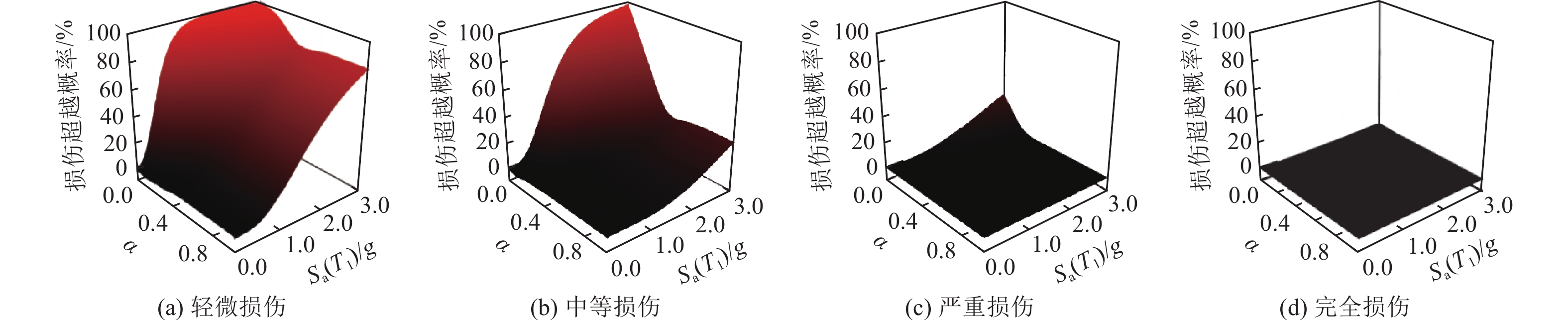
图 6 1#桥墩易损性随α变化情况
Figure 6. Variation of fragility of bents 1# with respect to changes in α
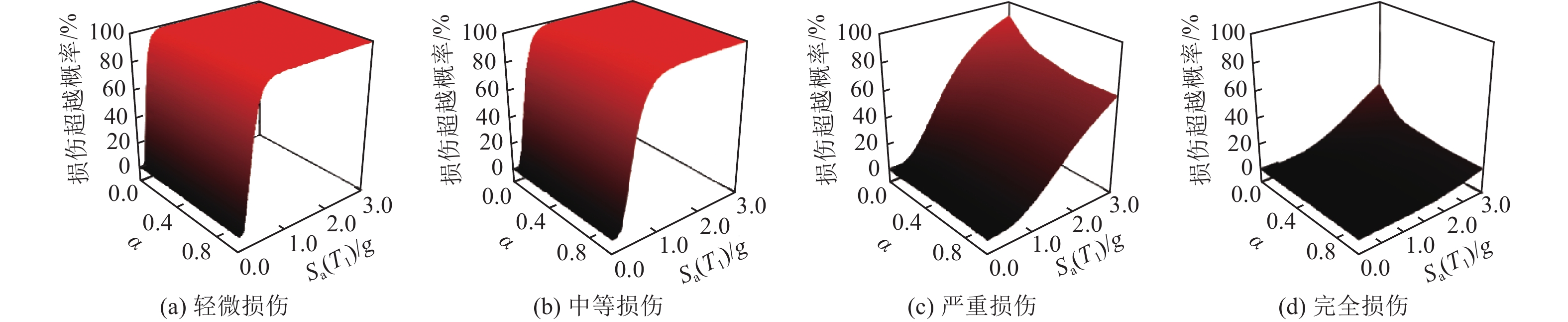
图 7 2#桥墩易损性随α变化情况
Figure 7. Variation of fragility of bents 2# with respect to changes in α
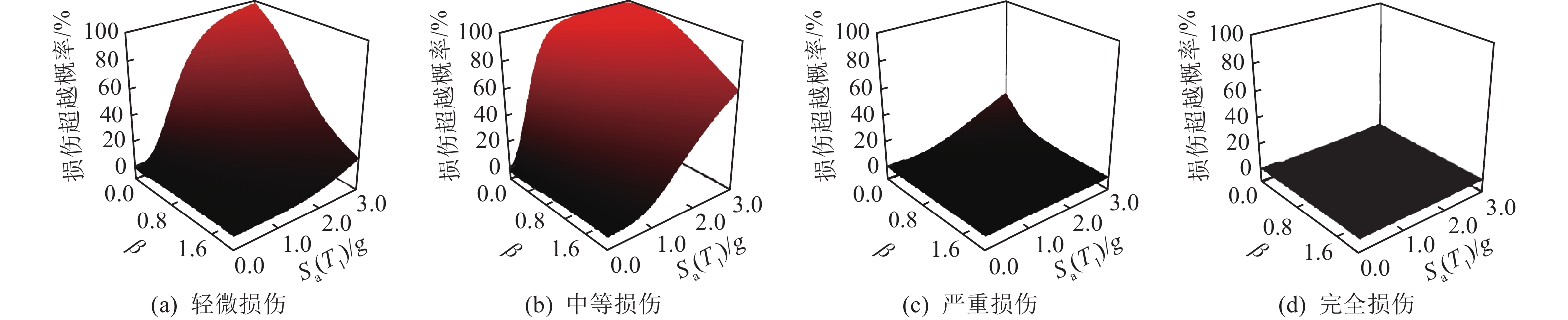
图 8 1#桥墩易损性随β变化情况
Figure 8. Variation of fragility of bents 1# with respect to changes in β
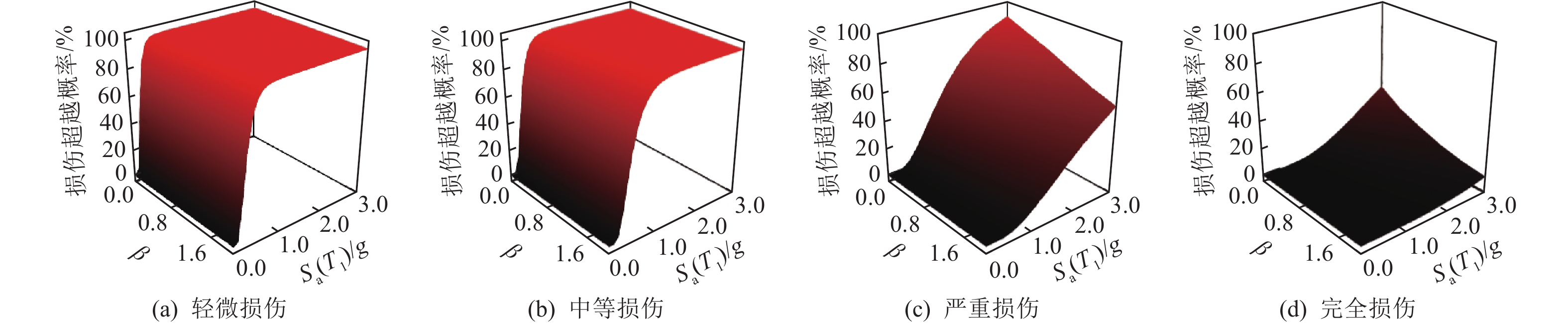
图 9 2#桥墩易损性随β变化情况
Figure 9. Variation of fragility of bents 2# with respect to changes in β
表 1 铅芯橡胶支座(LRB)性能参数
Table 1. Performance parameters of lead rubber bearings (LRB)
构件 型号 FN/kN Fy/kN Ke/(kN·m−1) Kd/(kN·m−1) 桥台 Y4 Q620×229 2 700 142 7 100 1 100 桥墩 Y4 Q670×232 3 200 162 8 600 1 300  下载: 导出CSV
表 2 桥墩基本设计参数
Table 2. Basic design parameters of pier
关键参数 1#墩、4#墩 2#墩、3#墩 墩高/m 9 16 设计位移xd/m 0.034 8 0.0590 设计地震力Fd/kN 2.48 2.8 屈服位移比α 1.9 2.5
下载: 导出CSV
表 3 前5阶周期和振型
Table 3. The first five orders of periods and vibration modes
阶数 周期/s 振型描述 振型图 1阶 0.87 主梁沿纵桥向1阶振动 
2阶 0.85 主梁沿横桥向1阶振动 
3阶 0.68 主梁沿横桥向2阶振动 
4阶 0.42 主梁沿横桥向3阶振动 
5阶 0.26 主梁沿纵桥向2阶振动和桥墩纵向振动  下载: 导出CSV
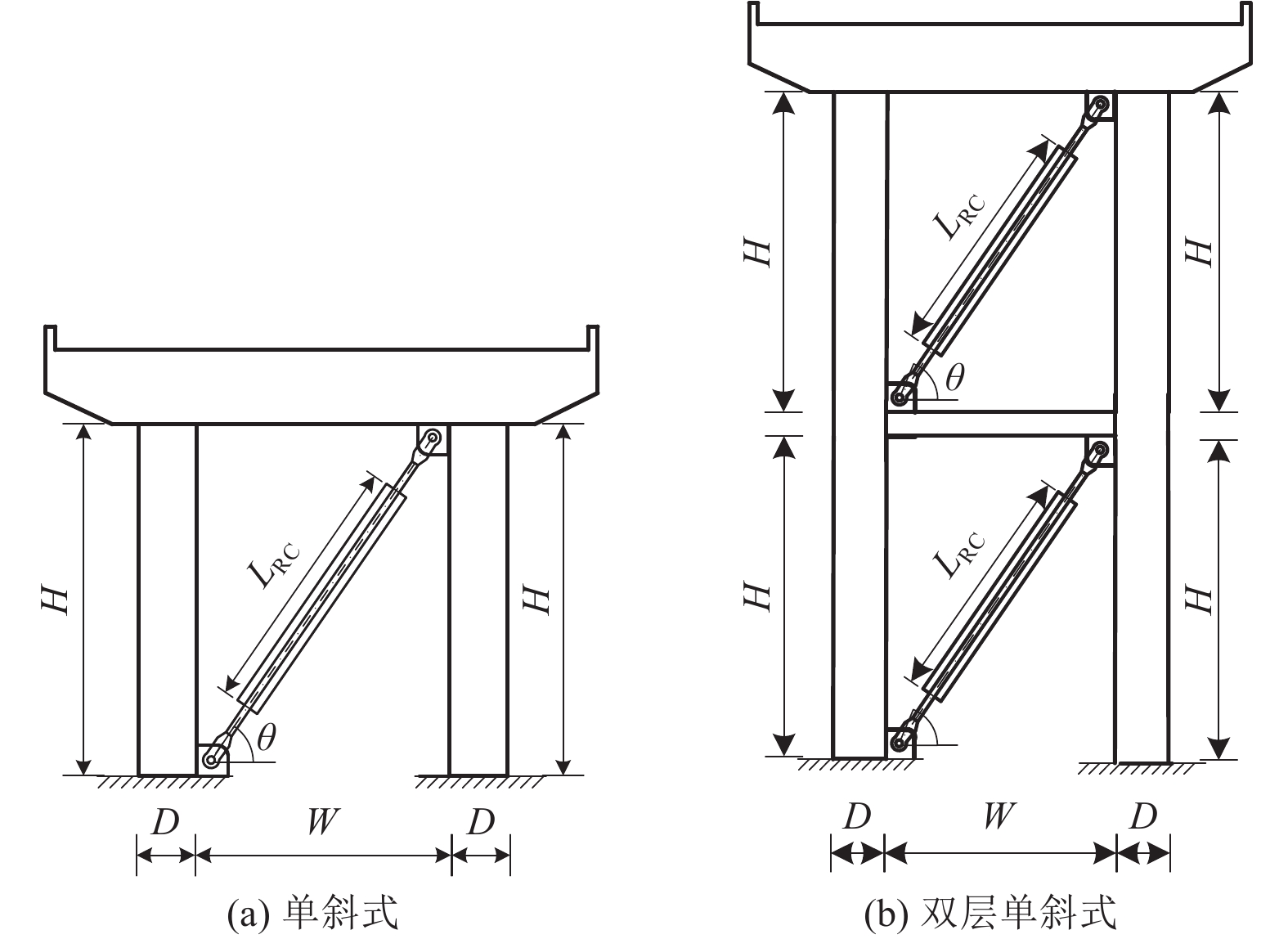
表 4 BRB具体设计参数
Table 4. Specific design parameters of BRB
布置形式 单斜式 单斜式(双层) 位移放大系数f1 0.591 0.625 轴向屈服强度FRy/kN 1427 496 轴向屈服位移ΔRy/mm 5.35 7.45 轴向初始刚度KRi/(kN·m−1) 2.7×10⁵ 6.7×10⁴ 轴向设计强度FRd/kN 1512 536 轴向设计位移ΔRd/mm 21.4 37.2 核心段长度LRC/m 4.55 6.34 设计长度比ϕ 0.408 0.611 长度比允许范围 0.318<ϕ<1.0 0.49<ϕ<1.0 截面有效面积AR/m2 5.8×10⁻³ 2.05×10⁻³
下载: 导出CSV
表 5 各桥墩损伤指标计算结果
Table 5. Calculatied results of damage indices for each bridge bents
桥墩 墩高/m μcy1 μcy μc4 μcmax 1#墩 9 1.00 1.36 4.02 7.02 2#墩 16 1.00 1.18 4.35 7.35 3#墩 9 1.00 1.36 4.02 7.02 4#墩 16 1.00 1.18 4.35 7.35
下载: 导出CSV
表 7 桥墩地震反应回归分析
Table 7. Regression analysis of bridge bents seismic response
位置 方程 $ {R}^{2} $ $ {\beta }_{\mathrm{D}} $ 1#桥墩(原桥) y= 0.59853 x+0.36956 0.80907 0.21947 1#桥墩(设置BRB) y= 0.45854 x−0.44464 0.77880 0.18446 2#桥墩(原桥) y= 0.75474 x+1.11335 0.86042 0.22946 2#桥墩(设置BRB) y= 0.63247 x+0.75290 0.84892 0.20140
下载: 导出CSV
表 8 支座地震反应回归分析
Table 8. Regression analysis of bearing seismic response
位置 方程 $ {R}^{2} $ $ {\beta }_{\mathrm{D}} $ 桥台处支座(原桥) y= 1.07422 x+0.61171 0.8393 0.3548 桥台处支座(设置BRB) y= 1.07349 x+0.54506 0.85338 0.33586 1#桥墩处支座(原桥) y= 1.08723 x+0.51508 0.85599 0.33661 1#桥墩处支座(设置BRB) y= 0.99210 x+0.52897 0.86477 0.29613 2#桥墩处支座(原桥) y= 0.96618 x−0.12621 0.77819 0.38936 2#桥墩处支座(设置BRB) y= 1.00716 x+0.18282 0.84231 0.32893 注:R2为相关系数;βD为地震需求D的对数标准差。
下载: 导出CSV
-
陈乐生, 庄卫林, 赵河清等, 2012. 汶川地震公路震害调查: 桥梁. 北京: 人民交通出版社.Chen L. S., Zhuang W. L., Zhao H. Q., et al., 2012. Report on highways′ damage in the Wenchuan earthquake: bridge. Beijing: People's Communications Publishing House. (in Chinese) 李宏男, 成虎, 王东升, 2018. 桥梁结构地震易损性研究进展述评. 工程力学, 35(9): 1−16.Li H. N., Cheng H., Wang D. S., 2018. A review of advances in seismic fragility research on bridge structures. Engineering Mechanics, 35(9): 1−16. (in Chinese) 李立峰, 吴文朋, 黄佳梅等, 2012. 地震作用下中等跨径RC连续梁桥系统易损性研究. 土木工程学报, 45(10): 152−160.Li L. F., Wu W. P., Huang J. M., et al., 2012. Study on system vulnerability of medium span reinforced concrete continuous girder bridge under earthquake excitation. China Civil Engineering Journal, 45(10): 152−160. (in Chinese) 梁晓, 姜浩然, 李芳芳, 2024. 自复位预制节段拼装中空夹层钢管混凝土桥墩地震易损性分析. 震灾防御技术, 19(3): 613−628. doi: 10.11899/zzfy20240319Liang X., Jiang H. R., Li F. F., 2024. Seismic fragility analysis of self-centering precast segmental concrete-filled double skin steel tubular piers. Technology for Earthquake Disaster Prevention, 19(3): 613−628. (in Chinese) doi: 10.11899/zzfy20240319 刘黎明, 徐超, 卜春尧等, 2021. 双向水平地震动作用对某钢筋混凝土连续梁桥易损性的影响. 震灾防御技术, 16(4): 671−679.Liu L. M., Xu C., Bu C. Y., et al., 2021. Influence of Bi-directional horizontal ground motion on the vulnerability of a reinforced concrete continuous beam bridge. Technology for Earthquake Disaster Prevention, 16(4): 671−679. (in Chinese) 刘子舟, 王东升, 陈磊等, 2020. 近断层地震动下设置BRB的双向减隔震桥梁地震反应. 世界地震工程, 36(2): 155−162. doi: 10.3969/j.issn.1007-6069.2020.02.017Liu Z. Z., Wang D. S., Chen L., et al., 2020. Seismic response of bidirectional isolation bridges using BRBs under near-fault ground motions. World Earthquake Engineering, 36(2): 155−162. (in Chinese) doi: 10.3969/j.issn.1007-6069.2020.02.017 马海滨, 卓卫东, 林杰等, 2016. 基于云图法的规则桥梁概率地震需求模型. 工程力学, 33(S1): 119−124.Ma H. B., Zhuo W. D., Lin J., et al., 2016. A probabilistic seismic demand model for regular highway bridges by cloud approach. Engineering Mechanics, 33(S1): 119−124. (in Chinese) 秦洪果, 李萍, 石岩等, 2022. 基于耗能保险丝的桥梁双柱墩减震控制研究. 振动与冲击, 41(14): 190−198, 263.Qin H. G., Li P., Shi Y., et al., 2022. Seismic damage control of bridge bents with double columns based on structural fuses. Journal of Vibration and Shock, 41(14): 190−198,263. (in Chinese) 石岩, 王东升, 韩建平, 2017a. 设置BRB桥梁排架墩基于位移抗震设计方法. 土木工程学报, 50(7): 62−68, 128. doi: 10.15951/j.tmgcxb.2017.07.007Shi Y., Wang D. S., Han J. P., 2017a. Displacement-based design method for bridge bents with buckling-restrained braces (BRBs). China Civil Engineering Journal, 50(7): 62−68,128. (in Chinese) doi: 10.15951/j.tmgcxb.2017.07.007 石岩, 王东升, 韩建平等, 2017b. 桥梁减隔震技术的应用现状与发展趋势. 地震工程与工程振动, 37(5): 118−128.Shi Y., Wang D. S., Han J. P., et al., 2017b. Application status of seismic isolation for bridges and its development tendency. Earthquake Engineering and Engineering Dynamics, 37(5): 118−128. (in Chinese) 石岩, 李军, 秦洪果等, 2021. 桥梁双柱式排架墩抗震性能研究进展述评. 中国公路学报, 34(2): 134−154. doi: 10.19721/j.cnki.1001-7372.2021.02.004Shi Y., Li J., Qin H. G., et al., 2021. Review on seismic performance of bridge double-column bents. China Journal of Highway and Transport, 34(2): 134−154. (in Chinese) doi: 10.19721/j.cnki.1001-7372.2021.02.004 孙治国, 华承俊, 石岩等, 2015. 利用BRB实现桥梁排架基于保险丝理念的抗震设计. 振动与冲击, 34(22): 199−205.Sun Z. G., Hua C. J., Shi Y., et al., 2015. Seismic design of bridge bents with BRB as a structural fuse. Journal of Vibration and Shock, 34(22): 199−205. (in Chinese) 谢文, 孙利民, 2016. 基于结构“保险丝”概念的双柱式高墩地震损伤控制研究. 振动工程学报, 29(3): 420−428. doi: 10.16385/j.cnki.issn.1004-4523.2016.03.007Xie W., Sun L. M., 2016. Investigation on seismic damage control of twin-column tall piers based on structural fuse concept. Journal of Vibration Engineering, 29(3): 420−428. (in Chinese) doi: 10.16385/j.cnki.issn.1004-4523.2016.03.007 于晓辉, 2012. 钢筋混凝土框架结构的概率地震易损性与风险分析. 哈尔滨: 哈尔滨工业大学.Yu X. H., 2012. Probabilistic seimic fragility and risk analysis of reinforced concrete frame structures. Harbin: Harbin Institute of Technology. (in Chinese) 张智超, 2023. 设置耗能保险丝的桥梁排架墩设计方法及抗震性能评估. 兰州: 兰州理工大学.Zhang Z. C., 2023. Seismic performance evaluation and design method for bridge bents retrofit with structural fuses. Lanzhou: Lanzhou University of Technology. (in Chinese) Chen X., Li C. X., 2021. Seismic assessment of tall pier bridges with double-column bents retrofitted with buckling restrained braces subjected to near-fault motions. Engineering Structures, 226: 111390. doi: 10.1016/j.engstruct.2020.111390 Cornell C. A., Jalayer F., Hamburger R. O., et al., 2002. Probabilistic basis for 2000 SAC federal emergency management agency steel moment frame guidelines. Journal of Structural Engineering, 128(4): 526−533. doi: 10.1061/(ASCE)0733-9445(2002)128:4(526) Dong H. H., Du X. L., Han Q., et al., 2019. Hysteretic performance of RC double-column bridge piers with self-centering buckling-restrained braces. Bulletin of Earthquake Engineering, 17(6): 3255−3281. doi: 10.1007/s10518-019-00586-4 El-Bahey S., Bruneau M., 2011. Buckling restrained braces as structural fuses for the seismic retrofit of reinforced concrete bridge bents. Engineering Structures, 33(3): 1052−1061. doi: 10.1016/j.engstruct.2010.12.027 Federal Emergency Management Agency (FEMA), 1999. Earthquake loss estimation methodology−Hazus99, Technical Manual, Washington, DC. Jalayer F., De Risi R., Manfredi G., 2015. Bayesian cloud analysis: efficient structural fragility assessment using linear regression. Bulletin of Earthquake Engineering, 13(4): 1183−1203. doi: 10.1007/s10518-014-9692-z Nielson B. G. , 2005. Analytical fragility curves for highway bridges in moderate seismic zones. Atlanta: Georgia Institute of Technology. Padgett J. E. , 2007. Seismic vulnerability assessment of retrofitted bridges using probabilistic methods. Atlanta: Georgia Institute of Technology. Shi Y., Zhong Z. W., Qin H. G., et al., 2020. Toggle buckling-restrained brace systems and a corresponding design method for the seismic retrofit of bridge bents. Engineering Structures, 221: 110996. doi: 10.1016/j.engstruct.2020.110996 Shome N. L., Cornell C. A., Bazzurro P., et al., 1998. Earthquakes, records, and nonlinear responses. Earthquake Spectra, 14(3): 469−500. doi: 10.1193/1.1586011 Wang Y. D., Ibarra L., Pantelides C., 2016. Seismic retrofit of a three-span RC bridge with buckling-restrained braces. Journal of Bridge Engineering, 21(11): 04016073. doi: 10.1061/(ASCE)BE.1943-5592.0000937 Xiang N. L., Goto Y., Obata M., et al., 2019. Passive seismic unseating prevention strategies implemented in highway bridges: a state-of-the-art review. Engineering Structures, 194: 77−93. doi: 10.1016/j.engstruct.2019.05.051 Zakeri B., Padgett J. E., Amiri G. G., 2014. Fragility analysis of skewed single-frame concrete box-girder bridges. Journal of Performance of Constructed Facilities, 28(3): 571−582. doi: 10.1061/(ASCE)CF.1943-5509.0000435 Zhang J., Huo Y. L., 2009. Evaluating effectiveness and optimum design of isolation devices for highway bridges using the fragility function method. Engineering Structures, 31(8): 1648−1660. doi: 10.1016/j.engstruct.2009.02.017 Zhang Z. H., Zhang J. S., Wang L., et al., 2021. A novel lever-based-inerter-enhanced self-centering damping system to retrofit double-column bridge bent. Soil Dynamics and Earthquake Engineering, 151: 107003. doi: 10.1016/j.soildyn.2021.107003 -

 点击查看大图
计量
- 文章访问数: 268
- HTML全文浏览量: 103
- PDF下载量: 186
- 被引次数: 0
